

BlogPilot vs. the Competition: What’s Actually Different
BlogPilot SEO features vs competitors is a critical decision point for any creator, agency, or freelancer scaling content production without burning through editorial budgets. The comparison matters because different autoblogging platforms handle keyword research, internal linking, and content optimization in fundamentally different ways. Some tools treat SEO as an afterthought; others bake it into every stage of content generation and publishing.
Definition and Background
BlogPilot is a WordPress-native AI content automation plugin designed to help SMBs, freelancers, and agencies publish SEO-optimized blog posts at scale. Weighing BlogPilot SEO features vs competitors comes down to how each platform approaches the core challenge: generating, optimizing, and publishing content that ranks without requiring a dedicated SEO specialist on staff. The competitive landscape includes platforms like Jasper, Copy.ai, Surfer SEO integrations, and native WordPress competitors.
The clearest structural difference between these platforms is where the SEO work happens. Most competitors require separate tools for keyword research, content writing, and SEO optimization, leaving you to stitch the workflow together. BlogPilot consolidates those steps inside WordPress itself, which removes the export-and-paste stage that consumes most of the manual time in a scaled publishing operation.
Why It Matters
AI-assisted publishing is no longer a differentiator on its own — a large share of newly published pages now contain some AI-generated content, and most marketing teams report using AI somewhere in their content process. That shift means the platform you choose is judged on how well it optimizes and publishes, not merely on how fast it writes.
Google’s own position sharpens the point. Its guidance on AI-generated content states that appropriate use of AI or automation is not against its guidelines, while its spam policies treat mass-produced pages that add no value as scaled content abuse regardless of whether a human or a model wrote them. The distinction Google draws is between content produced with automation and content produced only to game rankings. Your platform choice determines which side of that line your output lands on.
For e-commerce sites, coaches, and SaaS founders relying on content funnels to drive sales, this distinction determines whether your automated content engine becomes a revenue generator or an expense center. The comparison isn’t academic — it’s about which platform saves you the most money, time, and ranking risk while still delivering consistent organic growth.
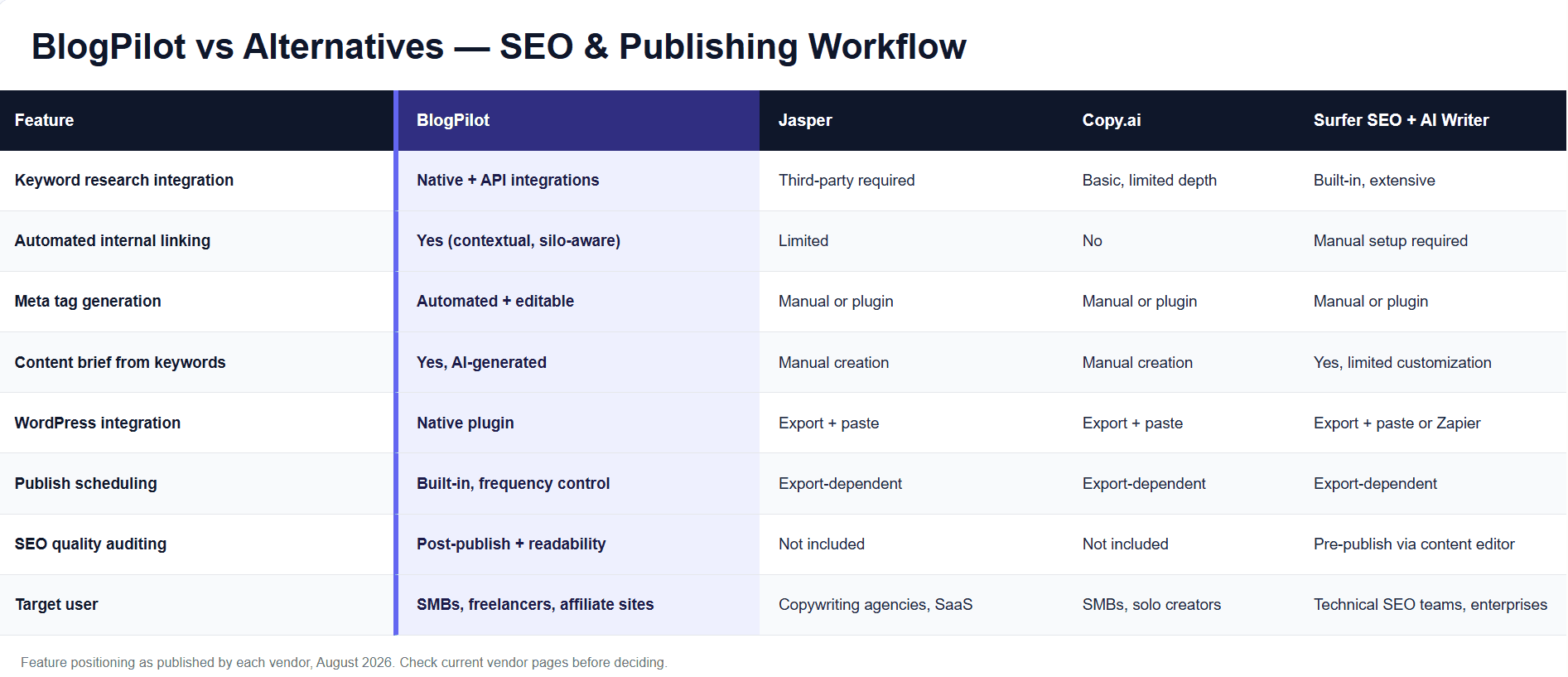
BlogPilot vs Top Competitors: Direct Comparison Table
| Feature Category | BlogPilot | Jasper | Copy.ai | Surfer SEO + AI Writer |
|---|---|---|---|---|
| Keyword Research Integration | Native + API integrations | Third-party required | Basic, limited depth | Built-in, extensive |
| Automated Internal Linking | Yes (contextual, silo-aware) | Limited | Not a native feature | Manual setup required |
| Meta Tag Generation | Automated + editable | Manual or plugin | Manual or plugin | Manual or plugin |
| Content Brief from Keywords | Yes, AI-generated | Manual creation | Manual creation | Yes, limited customization |
| WordPress Integration | Native plugin | Export + paste | Export + paste | Export + paste or Zapier |
| Publish Scheduling | Built-in, frequency control | Export-dependent | Export-dependent | Export-dependent |
| SEO Quality Auditing | Post-publish + readability | Not a built-in feature | Not a built-in feature | Pre-publish via content editor |
| Target User | SMBs, freelancers, affiliate sites | Copywriting agencies, SaaS | SMBs, solo creators | Technical SEO teams, enterprises |
Key Benefits of BlogPilot’s SEO Approach
Primary Advantages
BlogPilot pulls ahead of the competition in three specific dimensions that matter most to your bottom line: automation depth, publishing velocity, and SEO consistency.
- Contextual Internal Linking: BlogPilot analyzes your existing content silo and suggests internal links based on topic relevance and keyword overlap, not just anchor text matching. Competitors either force manual linking or use basic string-matching, which produces links that read as bolted-on rather than editorial.
- Native WordPress Publishing: BlogPilot posts directly to your WordPress database, scheduling and categorizing automatically. Jasper, Copy.ai, and Surfer require export-and-paste workflows, adding friction and error risk at every article. That’s the difference between hands-off publishing and babysitting the process.
- AI-Generated Content Briefs from Keywords: Instead of manually creating outlines or briefs, BlogPilot generates content structures directly from target keywords and their classified genre. Every post starts with a structure appropriate to its funnel stage, not a blank page.
- Post-Publish SEO Auditing: BlogPilot includes readability scoring, keyword density checks, and meta tag validation right in the publishing interface. Competitors leave this to third-party tools, fragmenting your workflow across several subscriptions.
Who Benefits Most
This comparison reveals clear winner profiles. Affiliate site operators and e-commerce brands running content funnels benefit most because they need high-velocity content with consistent keyword targeting. Coaches and SaaS founders scaling lead magnets gain from automatic topical cluster generation. Agencies managing several client blogs simultaneously save the most time, because they’re not re-integrating separate tools for each brand.
Surfer SEO appeals more to technical SEO teams with the budget and bandwidth to manage tool integrations. Jasper works better for copy-focused agencies that prioritize brand voice over publishing scale. Copy.ai attracts solo creators who need basic AI writing without the SEO layer. Put simply, BlogPilot SEO features vs competitors comes down to workflow: for SMBs and freelancers who need a set-it-and-review-it content engine, BlogPilot’s architecture wins the comparison.
How to Get Started with BlogPilot’s SEO Features
Step-by-Step Overview
Starting with BlogPilot and comparing its SEO features vs competitors becomes practical when you follow this sequence:
- Install the Plugin: Install BlogPilot, activate it, and connect your API keys — an Anthropic key for content generation, plus a DataForSEO account if you want deeper keyword research.
- Audit Your Existing Content: Run Site Diagnostics on your live site. It scores topical authority per niche and flags thin content, orphaned posts, broken links and content gaps — the same signals BlogPilot uses when placing internal links in new posts.
- Create Your First Keyword List: Run keyword discovery for a niche, or add seed keywords manually, then build topic clusters so related keywords group around a pillar post.
- Generate, Review, and Schedule: Queue keywords and generate. Review each draft for factual accuracy — AI still needs human eyes — tweak as needed, then let the scheduler publish on your chosen cadence.
- Monitor Performance: After 30 days, compare organic traffic, ranking velocity, and internal link clicks against your baseline. That data tells you whether BlogPilot is actually outperforming whatever you were using before.
Tools and Resources You Need
To compare BlogPilot SEO features vs competitors meaningfully, you’ll need parallel access to at least one alternative. The most practical setup:
- WordPress 6.2+ on a performance-friendly hosting plan
- API access for your chosen keyword research source
- An AI provider account for content generation
- A content analytics dashboard — Google Search Console at minimum
- Trial access to at least one competitor platform for direct comparison
Common Mistakes to Avoid When Choosing an Autoblogging Platform
Mistake #1: Prioritizing Price Over Publishing Workflow
The cheapest platform isn’t always the fastest. A tool that requires manual export-and-publish workflows costs you hours every month in labor once you’re publishing twenty or more posts. A slightly higher subscription that includes native WordPress integration and automatic scheduling can be cheaper per published post. When comparing BlogPilot SEO features vs competitors on budget alone, you’re ignoring the labor multiplier. Calculate your true cost-per-post including your time, not just the subscription fee.
Mistake #2: Assuming All AI Content Needs the Same SEO Tweaks
AI-generated content from different platforms requires different optimization approaches. Some tools produce polished prose that is weakly keyword-targeted; others hit the keyword but need heavier editing for readability. This is exactly where BlogPilot SEO features vs competitors starts to diverge in practice — the mistake is treating all AI output as equivalent and assuming any SEO tool will fix it equally well. Your choice of platform determines how much refining you’ll actually do after generation, which directly caps your sustainable publishing cadence.
How to Prevent Them
Before selecting any tool, run a short trial with your actual workflow. Generate three to five articles, publish them following each platform’s native process, then measure:
- Time elapsed from keyword input to published post, including any manual optimization
- Quality score on readability and on-page SEO audits
- How many posts needed revision before publishing — lower is better
This removes opinion from the comparison of BlogPilot SEO features vs competitors. You’ll see immediately which platform matches your tolerance for post-publish tweaking and which saves the most wall-clock time.
Tips for Getting the Best Results From BlogPilot
Pro Tips
- Seed with High-Volume, Low-Difficulty Keywords First: Your first 20–30 posts should target keywords with modest search volume and low difficulty scores. This builds ranking velocity quickly and demonstrates your site can rank. BlogPilot SEO features vs competitors matter far less if your keyword strategy is weak.
- Batch Your Keyword Research: Instead of queueing one keyword at a time, discover and cluster in batches. Internal linking suggestions improve substantially when the system has more content context to work with.
- Review AI Output for Factual Accuracy, Not Just Grammar: Model hallucination is still real, and a fabricated statistic or citation is the fastest way to undermine E-E-A-T. Spend a few minutes per post verifying claims, especially in health, finance, or technical niches.
- Use Category Taxonomy to Reinforce Topical Authority: Each BlogPilot niche maps to a WordPress category, so organize your keywords into four to six core silos before publishing and let clustering build the connections within them.
Advanced Techniques
Once you’ve published 30+ posts, the BlogPilot SEO features vs competitors gap widens further if you leverage these deeper features:
- Catch Declining Posts Early: Connect Google Search Console and use the signal buckets — low-hanging, boost, fix-CTR — to find posts slipping in position or under-performing on clicks. Refresh keyword targeting and internal links on those rather than publishing something new.
- Programmatic Topic Clustering: Map your keyword list to buyer journey stages — awareness, consideration, decision — then let each cluster’s T/M/B funnel bar show you where the gaps are. This turns scattered blog posts into a coherent funnel asset.
- A/B Test Meta Descriptions at Scale: Take ten published posts, rewrite their descriptions manually, and compare click-through rates in Google Search Console over 30 days. Use the winning patterns to inform how you edit future auto-generated descriptions.
Frequently Asked Questions About BlogPilot SEO Features vs Competitors
Can BlogPilot beat Surfer SEO on content quality? Not on granular on-page analysis. Surfer excels at competitive SERP analysis and detailed optimization recommendations. BlogPilot trades some of that depth for automation speed and native WordPress integration. If your team has bandwidth for manual optimization, Surfer wins. If you need hands-off publishing, BlogPilot wins.
Does BlogPilot’s internal linking actually improve rankings? Internal links help search engines understand site structure and topical relationships, and they distribute link equity between related pages. A contextual approach outperforms random anchor text linking, but quantity matters far less than relevance. Treat internal linking as one contributing factor rather than a standalone ranking lever.
What happens if I mix BlogPilot with competitors? It works, but it’s inefficient. Using one tool for copy and another for SEO publishing adds workflow steps and handoff errors. Better to standardize on one platform and supplement with specialized tools for keyword research and analytics as needed.
How does BlogPilot handle E-E-A-T requirements for Google? BlogPilot provides structure — a per-niche author identity with name and credentials, consistent formatting, and internal linking within topic silos. You provide the authority. For health or financial content you will still need to add credibility signals, expert review, and first-hand experience manually. This is where every AI writing platform falls short equally, and Google’s guidance is explicit that output quality, not production method, is what’s assessed.
Does BlogPilot work for non-English content? Yes, via the multilingual capability of the underlying AI model. Internal linking and SEO auditing work across languages, though keyword research data is thinner in smaller markets. For major European languages the platform is viable; for minority languages, expect gaps in keyword volume data.
The best autoblogging platform is the one you’ll actually use consistently. BlogPilot SEO features vs competitors matter only if you’re publishing at least ten posts monthly. Below that threshold, the automation ROI doesn’t materialize.
Final Verdict: BlogPilot SEO Features vs Competitors
BlogPilot SEO features vs competitors delivers the clearest win for SMBs, freelancers, and agencies publishing twenty or more posts monthly with limited editorial overhead. It consolidates keyword research, content generation, SEO optimization, and WordPress publishing into a single workflow. Jasper dominates if you prioritize copywriting quality and brand voice over scale. Surfer SEO wins for technical depth and competitive analysis. Copy.ai appeals to budget-conscious solo creators who don’t need native WordPress integration.
The practical choice depends on your content strategy. If you’re building topic clusters for topical authority and funnel optimization, BlogPilot’s internal linking and silo-aware publishing make the comparison lopsided in its favor. If you’re writing one-off articles or managing brand-heavy content, the comparison shifts toward Jasper. If you need enterprise-grade competitive SEO analysis, Surfer remains unmatched.
For your autoblogging ROI calculation, measure the outcome using three metrics only: cost-per-post including your labor time, ranking improvement measured as organic keywords in the top ten after 90 days, and content velocity measured as posts published per week. Run those numbers with a trial, and the comparison becomes arithmetic rather than opinion.
Still deciding? We can help. Try it free — no credit card required.
Stop choosing between speed and SEO quality. BlogPilot combines AI content generation with built-in SEO optimization—publish ranking-ready posts automatically.
More in this series
Get new posts by email
Pick the topics you care about — we only email you when something new is published in them.