
Disclosure: we are not affiliated with PastureMap and have no commercial relationship with them. This article is an assessment based on the vendor’s published documentation and pricing, not a hands-on trial. PigPal, linked at the end, is our own product.
Is PastureMap Worth It for Pig Farmers?
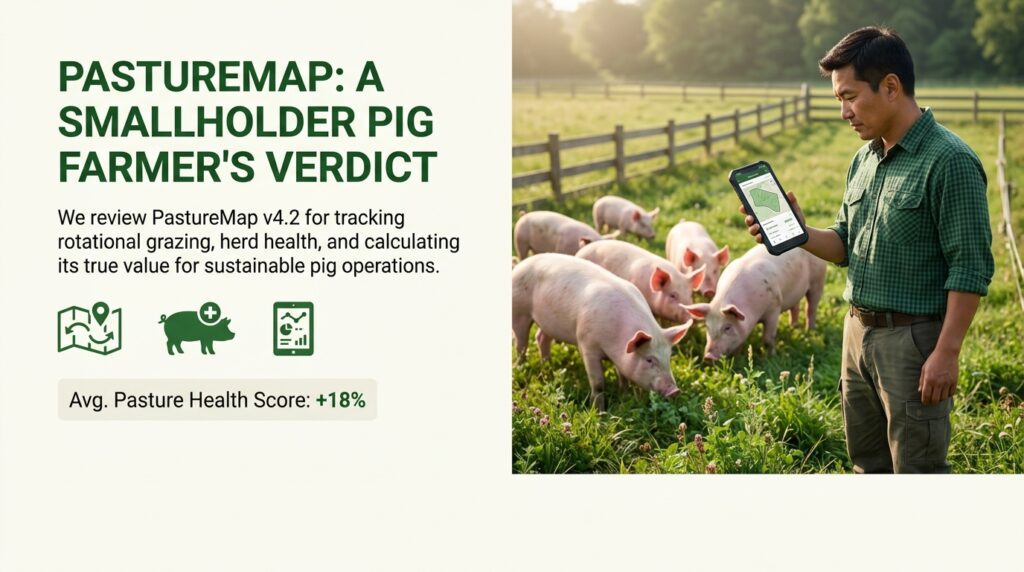
PastureMap is a cloud-based grazing management platform built for rotational grazing operations. The vendor positions it explicitly for cattle — its own site describes it as ranch management software for 50–300 head cattle operations. For pig farmers running outdoor or pasture-based systems, the useful question is not whether PastureMap works, but whether a cattle-designed tool earns its subscription on a swine herd.
So is PastureMap worth it for a pig farm? It can be — if your pigs actually rotate across several paddocks year-round. If they don’t, it isn’t.
What the platform actually does
The core features are digital pasture mapping over satellite imagery, herd movement tracking, forage and pasture-health records, and weather data tied to forage growth estimates. It runs as a mobile app with a web dashboard, on a subscription, and supports offline use in the field with syncing when you get back to a connection.
Everything in that list is species-agnostic in principle. The catch is that the defaults, the intake models and the help documentation are all written around cattle.
Why pasture rotation software matters for pigs at all
For outdoor pig systems, rotation drives three things: how much supplemental feed you buy, how quickly paddocks recover from rooting damage, and how well you control parasite load by resting ground. Any tool that makes rotation planning faster and the records more reliable is working on your feed bill and your herd health at the same time.
If your pigs live in confinement, or sit on one fixed paddock with occasional access to a second, none of that applies and the subscription is hard to justify.
Where PastureMap Helps a Pig Operation
Mapping and movement records
The clearest benefit is replacing paper or spreadsheet rotation records with a single map showing paddock layout, current herd location and rest days. On a farm running weekly moves across four or five paddocks, most of the planning time goes on reconstructing where the herd has been and how long each paddock has rested. A live map removes that reconstruction step.
Weather-linked forage estimates
PastureMap pulls local rainfall and temperature and uses it to estimate forage regrowth. For pigs, the value is in predicting when a rested paddock has recovered enough to take stock again — the decision most likely to be made optimistically by eye, and the one that causes lasting damage when it is wrong. Treat the estimate as a prompt to go and look, not as a verdict.
Offline field use
Maps and observation logging work without a connection and sync later. For anyone whose paddocks sit well outside WiFi range, this is the difference between records that get kept and records that don’t.
Who gets the most out of it
The case is strongest for:
- Pasture-based herds grazing year-round rather than seasonally
- Operations rotating across three or more paddocks, where rest tracking stops being memorable
- Farms deliberately trying to cut bought-in feed by grazing more of the ration
- Farmers who already keep digital records and want pasture data in the same habit
It is over-engineered for confinement systems and for static paddocks that rarely change.
What PastureMap Costs
PastureMap sells annual plans banded by animal numbers rather than by farm size. At the time of writing, the entry Starter tier covers roughly 100 animals and starts around $200 per year, with mid and Pro tiers rising to $750 or more for herds into the low thousands. Monthly billing is offered, and there is a free trial. Check the vendor’s pricing page before budgeting — tiers and figures change.
Whether that pays back depends on one number you can work out yourself: how much bought-in feed you replace with grazed forage. If better rotation lets you graze even a small additional share of the ration across a season, an entry-tier subscription is recovered quickly. If your pasture is already well utilised, the software is buying you time and record quality, not feed savings — which may still be worth it, but is a different argument.
Setting It Up for Pigs
The setup sequence
Expect to spend an afternoon on initial setup. You create an account, then map your paddocks over the built-in satellite imagery — the longest step, and one that scales with paddock count. Then you enter herd data: numbers, class of stock, grazing start date and expected intake.
That last field is where pig farmers hit friction. The defaults and the help documentation assume cattle intake, so you will be substituting your own figures for pigs by weight class. Budget time for this rather than accepting what the app suggests.
Ongoing use is short: log moves, record what you see in each paddock, review the recommendations. Fifteen to twenty minutes a week is realistic for a simple rotation.
What you need
- An iOS or Android phone or tablet
- An internet connection for setup and syncing — WiFi at the farm buildings is enough
- Reasonably accurate paddock areas
- Your own forage intake figures for the classes of pig you run
PastureMap does not integrate with pig-specific herd software, so if you keep breeding and health records elsewhere, expect manual entry or CSV exports to move data between them.
Mistakes to Avoid
Running cattle defaults on pigs
A finishing pig and a beef steer do not eat, move or damage ground the same way — pigs root, and the recovery a paddock needs after them is not the recovery it needs after cattle. Left on cattle assumptions, the app will tend to suggest a rotation rhythm that doesn’t match what your ground actually needs. Calibrate intake and recovery thresholds before you start acting on recommendations.
Letting observations lapse
The forage estimates are only as good as the observations you feed them — plant height, bare patches, water, pest pressure. Stop logging for a few weeks and the recommendations drift toward generic, which is exactly when an optimistic regrowth estimate can cost you a paddock. Tie logging to a walk you already do.
How to avoid both
Run one paddock through one full rotation in parallel with your existing method, comparing what the app suggests against what you see, without acting on it. That gives you a basis for calibration and a feel for how far off the cattle defaults are on your ground. If you also run cattle, keep separate paddock sets per species rather than mixing them in one module.
Getting More Out of It
Log observations in the paddock, not afterwards at a desk. Marking a bare patch or a wet hollow against the map while standing in front of it produces a record that is still useful a year later.
Use the notes field to record herd health events alongside pasture conditions. Scour or lameness that keeps recurring on one paddock, or after one forage change, only becomes visible when both sit in the same timeline.
If you run separate groups — dry sows, growers, finishers — set them up as distinct herds so intake and recovery are calculated per group. Nursing sows and finishers put very different pressure on ground, and averaging them hides that.
Export movement data periodically and set it against your feed invoices. Grazed forage per paddock versus bought-in feed is the number that tells you whether the subscription is earning its place.
Frequently Asked Questions
What does PastureMap cost?
Annual plans banded by animal numbers — roughly $200 a year at the entry tier, rising to $750 and above for larger herds, with monthly billing and a free trial available. Confirm current figures on the vendor’s site.
Can I use it with poor internet?
Yes. Maps and observation logging work offline and sync later. Setup and plan changes need a connection, so a farm with no connectivity anywhere is not a good fit.
Does it integrate with pig farm software?
Not directly. CSV export is the practical route, so pasture data and breeding or health records stay in separate systems unless you reconcile them manually.
Is it designed for pigs?
No — it is built for cattle and mixed grazing, and the vendor says so. Pig farmers can use it successfully, but only after replacing the cattle assumptions with their own figures. If you want software written around swine, look at dedicated pig management platforms as well.
Verdict
3.5 / 5 for pasture-based pig farms
Solid mapping, genuinely useful offline behaviour and sensible weather-linked forage estimates, held back for pig farmers by cattle-centric defaults and no swine integrations. Worth the subscription if you rotate a real herd across several paddocks year-round and currently track it on paper. Not worth it for confinement systems or static paddocks — put the money into health and breeding records instead.
Manage your pig farm from your phone
PigPal keeps the records PastureMap doesn’t — vaccinations, breeding cycles, feed costs and pig weights, in one app built for small and commercial pig farmers. Free to start, no card required.
More in this series
- 7 Best Farmlogs Alternatives for Pig Farmers in 2026
- Porcitec Review 2026: Serious Swine Software, But Is It for You?
- PastureMap Review: Is It Right for Your Pig Farm in 2026?
- Agworld Review for Pig Farmers: An Honest 2026 Assessment
- Agworld vs Herdwatch for Pig Farmers: Which Fits Your Farm? (2026)
Get new posts by email
Pick the topics you care about — we only email you when something new is published in them.