
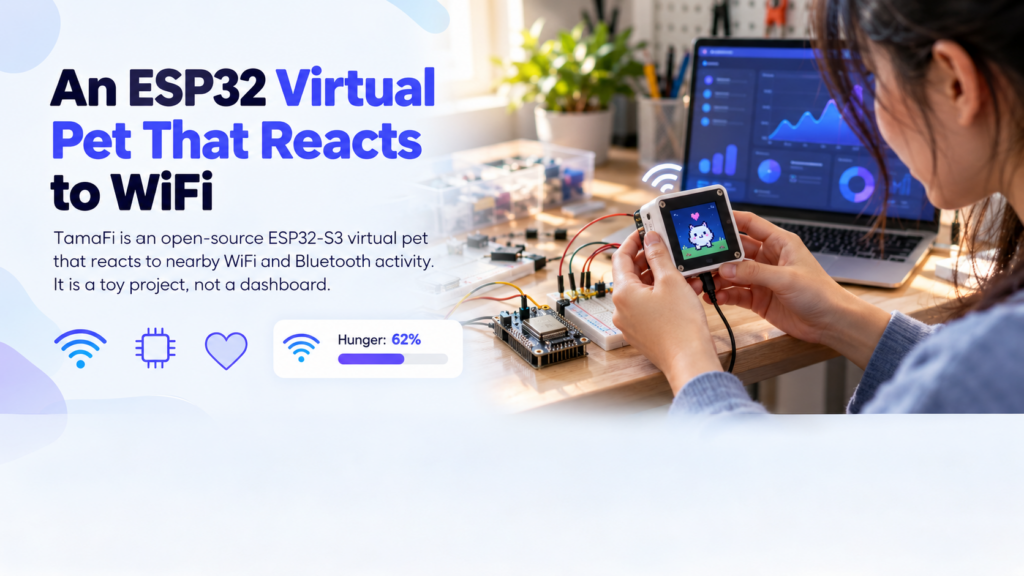
TamaFi is an open-source virtual pet that lives on an ESP32-S3 board and reacts to the WiFi and Bluetooth activity around it. It was created by CiferTech, not by me. I have not built one, and this write-up is based on the project’s GitHub page and the creator’s own Hackster write-up. I cover it because it is a good example of what an ESP32 can do when the goal is a toy, not a dashboard.
What TamaFi Is
TamaFi is a modern take on the Tamagotchi. The pet runs on the device itself and behaves on its own, hunting, exploring, resting or idling depending on its internal state and the radio environment. According to the GitHub page, nearby networks affect its hunger, happiness and health. The project is released under the MIT license, with code and schematics published, and CiferTech has also covered a second version on Hackaday.io.
How the TamaFi Pet Behaves
The Hackster write-up says TamaFi tracks six stats: hunger, energy, happiness, health, curiosity and comfort. The GitHub README describes hunger, happiness and health, so the stat list has probably grown between versions. It sorts the radio activity it sees into five states: calm, busy, open, noisy or hostile. Certain events trigger special reactions, including deauthentication events and bursts of probe requests. The pet grows through four life stages (baby, teen, adult and elder) based on survival time, average stats and environmental quality, and there is an achievements system with eleven milestones. The face is drawn in code rather than from sprite sheets.
TamaFi Hardware
- Board: an ESP32-S3-WROOM-1 module, which has dual cores with WiFi and Bluetooth.
- Display: an ST7789 screen at 240 by 240 pixels (1.3 to 1.54 inches).
- Sensors and audio: an INMP441 microphone, an MPU6050 motion sensor and a MAX98357A amplifier with a speaker. A light sensor is listed as planned.
- Power and controls: a single lithium cell charged through a TP4056 module over USB-C, four WS2812 RGB LEDs and six buttons.
The firmware is written for the Arduino IDE using the TFT_eSPI, Adafruit_NeoPixel and WiFi libraries. A desktop companion app called TamaFi Lab connects over USB for flashing firmware and live monitoring.
What Is Still Rough
The creator is open about the state of the project. The Hackster write-up calls it a work in progress with known USB connection timeout issues, and says the OV2640 camera connector on the board does not work because of a pinout error. The GitHub page describes version 2 as under active development, with stable core systems and the user interface still being refined.
What an ESP32 Builder Can Take From TamaFi
This section is my opinion, not something from the sources. The camera pinout error is a reminder to check every pin against the module’s datasheet before you send a board to fabrication, because a wrong pin usually cannot be fixed in firmware. The TamaFi Lab companion app is also worth noting: a small tool for flashing and monitoring makes a device much easier to hand to someone else. And the project shows that an ESP32-S3 has plenty of headroom for a full menu system, sound, LEDs and a behavior engine at once.
TamaFi is a standalone gadget, not an IoT platform. If you want to send an ESP32’s readings to a dashboard instead, the comparison of free dashboard tools for ESP32 is a better starting point, and the list of ESP32 project ideas for final-year students has more builds in this spirit.
A Note on Scanning Wireless Networks
The sources describe TamaFi reading and reacting to radio activity around it, including deauthentication events. They do not describe it sending attacks. Even so, rules about monitoring other people’s wireless traffic differ between countries, so check your local rules and only test on networks and devices you own or have permission to use.
Common Questions
Who made TamaFi? CiferTech, who published it on GitHub, Hackster and Hackaday.io. This article is not by the creator.
Is TamaFi open source? Yes. The GitHub project is under the MIT license.
Does TamaFi run on an ESP8266? No. The project is built around an ESP32-S3 module, so it is an ESP32 project, not an ESP8266 one.
Can I buy one? The sources I read describe it as a project you build yourself from published code and schematics. I did not find a finished product for sale in them.
Does it need an account or a subscription? Nothing in the sources mentions one. It is a standalone device with a desktop app for flashing and monitoring.
Get new posts by email
Pick the topics you care about — we only email you when something new is published in them.