
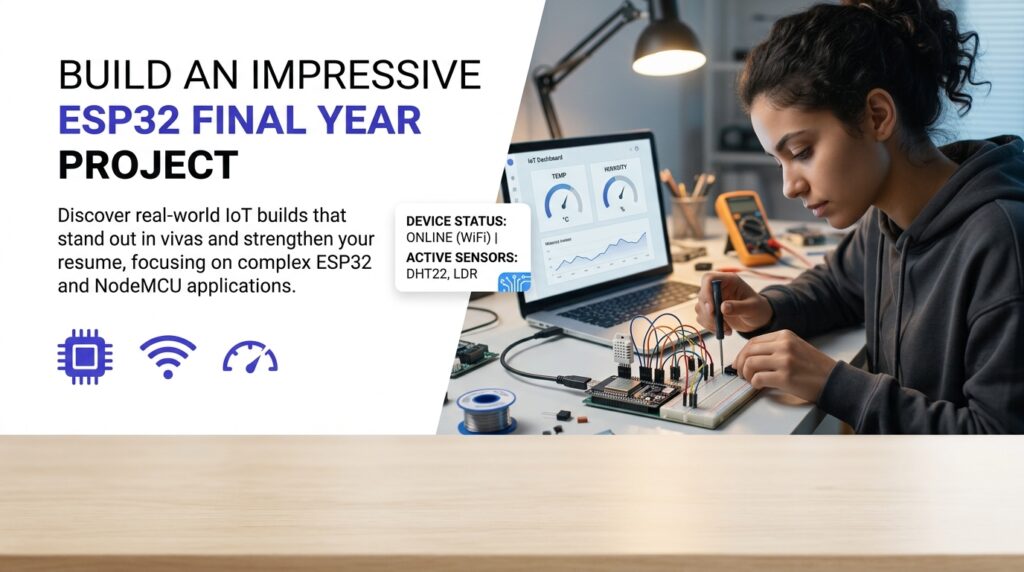
Choosing the right build from the available ESP32 project ideas for final year students can make the difference between a forgettable viva and a presentation that earns genuine attention from examiners. The ESP32 is a dual-core, Wi-Fi and Bluetooth-enabled microcontroller that Espressif Systems designed specifically for connected applications — and its sub-$5 price point makes it the default choice for budget-conscious engineering students worldwide. Before committing to a specific build, review the best free IoT dashboard tools for ESP32 so you know where your sensor data will actually live.
This list covers ten project concepts that are technically rigorous, presentable to a committee, and achievable without expensive lab equipment or paid cloud subscriptions. Each idea maps to a real engineering domain, which strengthens the academic argument you make in your report.
What Are ESP32 Project Ideas for Final Year Students
Definition and Background
Final year engineering projects are capstone assessments that require students to apply theory to a working prototype. ESP32 project ideas for final year students sit at the intersection of embedded systems, wireless communication, and cloud computing — three domains that examiners across electrical, computer, and mechatronics programmes recognise as industry-relevant. The ESP32’s built-in Wi-Fi stack, ADC channels, UART interfaces, and support for protocols such as MQTT and HTTP make it suitable for anything from environmental monitoring to motor control.
Why It Matters
According to the IoT Analytics 2024 State of IoT report, the number of connected IoT devices surpassed 16 billion globally. Examiners know this. A well-executed ESP32 build signals that a student understands the architecture behind that growth, not just how to blink an LED. Projects that stream live data to a dashboard, respond to thresholds, or integrate edge AI carry considerably more academic weight than static circuit demonstrations.
Key Benefits of Pursuing ESP32 Builds for Your Capstone
Primary Advantages
- Low hardware cost: An ESP32 development board, a handful of sensors, and a breadboard form a complete prototype for under $15 in most markets.
- Wi-Fi and Bluetooth on one chip: No separate wireless module is needed, which simplifies PCB design and reduces component count in the written report.
- Strong community documentation: Arduino IDE support, MicroPython compatibility, and thousands of open-source libraries mean fewer dead ends during development.
- Free cloud options: Platforms such as Nodik offer a free tier covering four devices with no credit card required — enough to run a live project demo during viva, not merely a crippled proof of concept.
- Resume value: Recruiters in embedded systems, IoT, and industrial automation roles recognise ESP32 experience as a concrete, verifiable skill.
Who Benefits Most
Students in electrical engineering, electronics and communication, computer science, and mechatronics gain the most from these project ideas for final year submissions. Hobbyists and self-taught makers who want a portfolio piece that reads like academic work also find this chip combination practical. The chip’s low power modes — particularly deep sleep — make it suitable for battery-powered field deployments, which widens the scope of viable project narratives.
Ten Builds Worth Considering
Below are ten distinct project directions. Each is designed to satisfy the complexity requirements of a final year submission while remaining achievable in a standard university lab environment.
- Environmental monitoring station: An ESP32 paired with a BME280 sensor pushes temperature, humidity, and pressure readings to an MQTT broker every 60 seconds. Live data is visualised on a free dashboard. This is a foundational idea for esp32 project ideas for final year students looking to demonstrate end-to-end IoT architecture. See the ESP32 DHT22 temperature dashboard guide for a working reference.
- Smart irrigation controller: Soil moisture sensors trigger a relay that opens a solenoid valve when moisture drops below a threshold. The system logs events to the cloud and sends alerts. This mirrors the architecture in the published ESP32 smart irrigation system build guide.
- GPS asset tracker: A NEO-6M GPS module feeds coordinates to an ESP32, which publishes location data via MQTT to a map widget. The ESP32 GPS tracker with live map walkthrough covers this build step by step.
- Water tank level monitor: An ultrasonic sensor measures tank depth and streams fill percentage to a live dashboard. Threshold alerts prevent overflow or dry-run pump damage. This is one of the most examiner-friendly project ideas for final year because the problem statement is universally understood.
- Home automation relay panel: The ESP32 controls multiple AC loads via relays, receives commands over Wi-Fi, and reports state back to a dashboard. Inspired by the trend of replacing commercial smart home gadgets with cheaper local hardware, this project demonstrates practical electrical engineering. The full setup is documented in the ESP32 home automation relay control guide.
- Edge AI anomaly detector: TensorFlow Lite Micro runs a trained model on the ESP32 to classify vibration signatures from an accelerometer. Anomalies trigger push alerts. This positions a student’s ESP32 final year project at the intersection of embedded ML and predictive maintenance — a strong academic angle.
- Motorized fader smart controller: Motorised linear faders (commonly used in audio mixers) are driven by an H-bridge attached to the ESP32, with position fed back via a potentiometer. Commands arrive over Wi-Fi. This concept — inspired by real-world smart home fader implementations — is a strong choice for students in electronics or audio engineering programmes.
- Indoor air quality monitor: An MQ135 gas sensor and a PMS5003 particulate sensor feed data to the ESP32. The device calculates a composite AQI score and displays it locally on an OLED while pushing to a cloud dashboard.
- Offline AI storytelling device: Running a compact language model on-device, the ESP32-S3 — which has more RAM than the original S1 — responds to voice triggers recorded by a microphone. This concept mirrors a widely covered project where a child built an offline AI storytelling device on a sub-$10 microcontroller, demonstrating that embedded AI is accessible even without server infrastructure.
- Borewell pump controller with telemetry: The ESP32 monitors pump current, motor temperature, and tank level simultaneously, pushing all fields to a cloud dashboard. A platform that caps free message volume will fail this kind of multi-field deployment quickly — 16 fields updating every five seconds exhausts free-tier quotas within days, as documented with Blynk. Nodik handles this workload on its free tier without message throttling.
Common Mistakes to Avoid
Mistake #1 — Choosing a Project Without a Clear Problem Statement
Many students pick an ESP32 build because the hardware is interesting, not because they can articulate the problem it solves. Examiners ask “why does this exist?” If the answer is vague, the grade suffers regardless of how clean the circuit is. Every viable final year project idea needs a one-sentence problem statement before a single wire is connected.
Mistake #2 — Relying on a Cloud Platform With Restrictive Free Tiers
Starting a multi-sensor project on a platform with a tight message quota creates a hard deadline that has nothing to do with your submission date. Blynk’s free tier, for example, can be exhausted in days by a telemetry-heavy build. Discovering this during the final week before viva is a common and entirely avoidable failure mode among students pursuing esp32 project ideas for final year submissions.
How to Prevent Them
Draft the problem statement and system architecture diagram before purchasing components. Confirm that every cloud service you plan to use supports your expected data rate on its free tier. Consult the ESP32 IoT project checklist before submission to catch infrastructure gaps early.
Tips for Getting the Best Results
Pro Tips
- Use ESP32 deep sleep between sensor readings for battery-powered builds — this extends runtime from hours to weeks and gives the project a field-deployable narrative.
- Implement OTA (Over-The-Air) firmware updates from the start. Being able to push a fix wirelessly during the viva demonstration is a detail that impresses committees.
- Version-control your firmware on GitHub from day one. Examiners appreciate seeing a commit history — it validates that the project developed iteratively rather than being assembled the night before.
- Structure your MQTT topics deliberately (e.g.,
project/sensor/temperature). A logical topic hierarchy shows architectural thinking, not just code execution.
Advanced Techniques
Students who want to push their ESP32 final year project ideas further should explore TLS-encrypted MQTT connections, which add a cybersecurity dimension to the report. Combining an ESP32 with an edge AI inference engine — TensorFlow Lite Micro or EloquentML — creates a machine learning chapter that most undergraduate projects do not include, and that distinction alone can separate a merit from a distinction grade. The edge AI gauge digitisation project is a practical reference for how inference runs on constrained hardware.
Frequently Asked Questions About Final Year ESP32 Builds
Which ESP32 board should a final year student buy first? The ESP32-WROOM-32 development board is the standard starting point — it is widely stocked, well-documented, and compatible with every major Arduino library. Students wanting more RAM for edge AI should look at the ESP32-S3.
Can these projects be completed without paid cloud subscriptions? Yes. Several platforms offer genuine free tiers with no credit card requirement. Nodik’s free plan supports four devices — sufficient for most esp32 project ideas for final year students that run a single prototype during evaluation.
How long does a typical ESP32 final year project take to build? A realistic timeline for a working prototype with documentation is eight to twelve weeks, assuming part-time effort alongside coursework. Projects involving custom PCB fabrication should add two to four weeks for board turnaround.
Is MicroPython or C++ (Arduino) better for academic submissions? Arduino C++ is preferred for most engineering programmes because it exposes memory management concepts that examiners expect students to discuss. MicroPython accelerates prototyping but may be viewed as higher-abstraction by committees evaluating embedded systems competency.
Can these ideas be extended into a published research paper? Builds that incorporate edge AI inference, energy harvesting, or novel sensor fusion have a reasonable path to a conference paper or journal letter. The environmental monitoring station and edge AI anomaly detector are the two concepts most frequently cited in IoT-related undergraduate research.
The range of viable esp32 project ideas for final year students is broad enough that almost every engineering discipline can find a build that aligns with its curriculum. The common thread across all successful submissions is the same: a clear problem, a working prototype, and live data that an examiner can see during the demonstration. Choose the project that solves a real problem in your environment, build the infrastructure before the hardware, and document every design decision. That combination produces submissions that stand out — regardless of the specific sensor or actuator involved.
Want to go deeper on any of these? Try it free — no credit card required.
Connect your ESP32 project to Nodik's free dashboard — 4 devices, no credit card, live data in minutes.
More in this series
- Best Free IoT Dashboard Tools for ESP32 (2026 Guide)
- ESP32 Push Notifications Without Blynk: 5 Ways to Stay Free
- ESP32 IoT Project Checklist Before Submission: The Complete Guide
- ESP32 Home Automation Relay Control From Phone: Complete Setup Guide
- ESP32 Smart Irrigation System for Agriculture: Step-by-Step Build Guide
- ESP32 DHT22 Temperature Dashboard: Build Your Own in 6 Steps
- ESP32 GPS Tracker With Live Map: Build Your Own in 7 Steps
- ESP32 Water Level Monitor With Live Dashboard: A Real-World Case Study
Get new posts by email
Pick the topics you care about — we only email you when something new is published in them.