
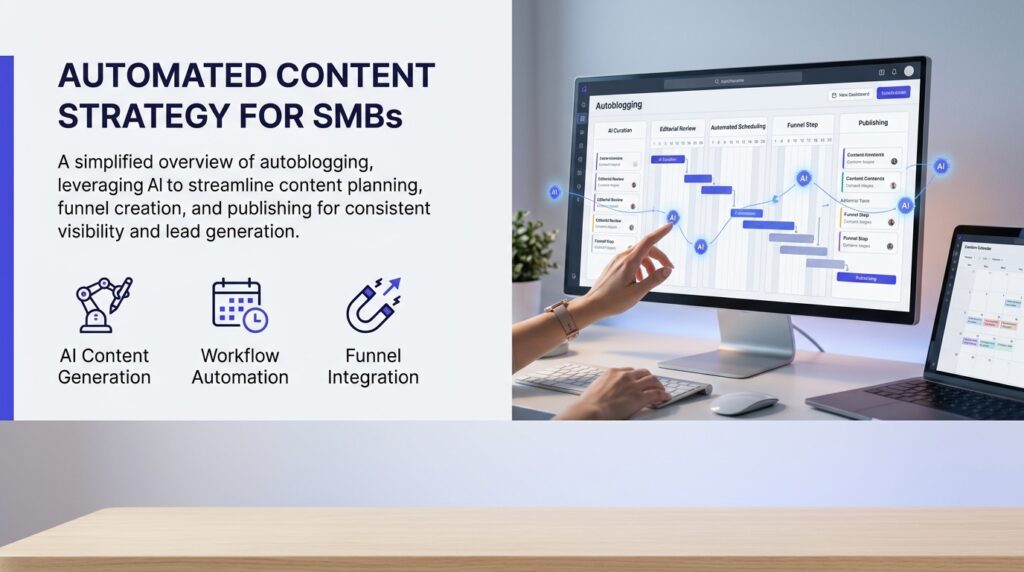
What Is Autoblogging
Autoblogging is the automated creation, optimization, and publishing of blog content using software systems and AI tools. Instead of manually writing, editing, and scheduling every post, autoblogging platforms handle the content pipeline—from topic research and writing to internal linking and publishing—on a schedule you define. For solo operators, small agencies, and content-heavy businesses, is autoblogging a time-saver? Absolutely. It’s a systematic approach to maintaining consistent publishing cadences without hiring a full editorial team.
Definition and Background
At its core, autoblogging refers to software that automates the workflow of content creation. The term emerged in the mid-2000s when bloggers first used feed aggregation tools to republish content from multiple sources. That early approach fell out of favor (and drew legitimate criticism for duplicate content). Modern autoblogging is fundamentally different: it uses AI writing models, keyword research APIs, and content management systems to generate original, optimized content tailored to your audience and SEO goals.
Today, is autoblogging powered by generative AI? Yes. Tools leverage large language models to draft blog posts, product reviews, case studies, and email content. The software then validates the output against plagiarism checks, inserts internal links, optimizes on-page SEO, and schedules publication. Some platforms integrate with your WordPress site directly, making the entire workflow invisible to you after setup.
Why It Matters
Content production is a real bottleneck for most SMBs and freelancers—many marketing teams simply can’t produce content as fast as they’d like to meet demand. Hiring writers costs $3,000–$10,000 per month for a dedicated resource. Freelance writers charge $50–$500 per article depending on quality and specialization. For a business publishing three posts per week, that’s a significant ongoing expense.
Autoblogging addresses this constraint directly. By automating the repetitive parts of content production, you free up budget and time to focus on strategy, conversion optimization, and customer relationships. For affiliate publishers, SaaS companies, and e-commerce businesses especially, is autoblogging essential? It’s become a competitive necessity—publishing at scale without automation means staying perpetually behind faster, leaner competitors.
The Upside for SMBs and Creators
Primary Advantages
The benefits of autoblogging stack up quickly for SMBs and creators:
- Consistent Publishing Cadence — Publish 3, 5, or 10 posts per week without manual intervention. Consistency signals authority to search engines and keeps your audience engaged.
- Lower Content Costs — Reduce per-article costs from $200–$500 to $20–$100 when using AI tools. Reinvest savings into other growth channels.
- SEO-Optimized Output — Most modern autoblogging platforms integrate keyword research, meta tag generation, and internal linking recommendations directly into the workflow.
- Scalable Funnel Management — Automate nurture sequences, segmentation, and lead scoring without writing every email or follow-up message manually.
- Time Freedom — Remove yourself from the creation loop. Review and approve (or schedule) posts in batches instead of obsessing over individual pieces.
- Data-Driven Topic Selection — AI tools analyze search volume, competition, and audience intent to suggest the highest-ROI topics to cover first.
Who Benefits Most
Autoblogging works best for specific business models. Affiliate publishers using autoblogging to publish product comparisons and buying guides at scale see the fastest ROI—each post is a potential revenue stream. SaaS companies use it to dominate informational keywords and build authority before converting readers into trial users. E-commerce brands use it to publish product roundups, how-to guides, and educational content that builds trust and drives organic traffic to product pages.
Agencies and freelancers also benefit: autoblogging offers a way to provide done-for-you blog services to clients without doubling headcount. One person can manage content production for five clients simultaneously when the workflow is automated.
Coaches and course creators use it to build email lists and nurture sequences automatically, transforming strangers into leads and leads into customers without manual follow-up overhead.
How to Get Started
Step-by-Step Overview
Getting autoblogging working for your business follows a repeatable process. Following these steps in order typically takes a new site from setup to its first automated post within days rather than weeks:
- Define Your Content Strategy — Identify 5–10 primary topics your audience searches for. Use tools like SEMrush, Ahrefs, or Google Search Console to find high-intent, low-competition keywords.
- Set Up Your Platform — Choose an autoblogging tool. Popular options include WP BlogPilot for WordPress sites, Surfer SEO for AI writing + optimization, or Copy.ai for pure content generation.
- Configure AI Writing Parameters — Specify tone, style, target word count, and brand voice. Train the AI on your existing content if the platform allows it.
- Build Topic Workflows — Create recurring publication schedules (e.g., publish a new post every Monday and Thursday) linked to specific keyword clusters or content pillars.
- Add Content Review Checkpoints — Decide whether posts auto-publish or go to a queue for human review. Early on, manual review prevents embarrassing errors and off-brand output.
- Monitor Performance — Track traffic, leads, and revenue from automated content. Adjust topics, publishing frequency, and AI settings based on performance data.
Tools and Resources You Need
You don’t need dozens of tools to run autoblogging effectively. A lean stack includes:
- Content Generation — An AI writing tool or platform with autoblogging features built-in.
- Keyword Research — Identify topics and search intent. Free options (Google Keyword Planner, Ubersuggest) work for startups; paid tools (SEMrush, Ahrefs) offer deeper insights.
- Content Management System — WordPress, Ghost, or other CMS to host and publish your content. WordPress integrates with most AI tools seamlessly.
- Analytics — Google Analytics 4 tracks traffic; Google Search Console shows keyword performance and indexing health.
- Email Marketing — ConvertKit, Mailchimp, or ActiveCampaign to nurture readers into customers using automated sequences.
Start with the essentials. You can add sophistication (image generation, video automation, social media scheduling) after your core autoblogging workflow is proven.
Common Mistakes to Avoid
Mistake #1: Publishing Without a Coherent Strategy
Many people approach autoblogging as a volume game—publish as much as possible and hope something ranks. This backfires. Search engines penalize sites with thin, unfocused content. Readers bounce from low-quality posts. Your authority actually declines rather than builds.
The antidote: choose a specific niche or topic cluster. If you sell project management software, don’t publish posts about fitness and nutrition just to add volume. Focus all content around productivity, team workflows, and business operations. This builds topical authority—search engines recognize your site as a credible resource in a specific area, and you rank higher for related queries.
Mistake #2: Ignoring Quality and User Experience
Early AI content sometimes reads awkwardly, repeats itself, or contains factual errors. Publishing unreviewed AI output damages your brand and trust with readers. Google has stated publicly that using AI to generate content isn’t against its guidelines—but content produced primarily to manipulate rankings, AI-written or not, falls under its policies on low-value, mass-produced content and can be actioned regardless of how it was created.
The fix: build human review into your autoblogging workflow. Spend 10 minutes reviewing each post before it publishes. Check for accuracy, brand voice consistency, and readability. Remove jargon clutter. Verify statistics. Add personal examples where relevant. This small investment protects your reputation and improves content performance.
How to Prevent Them
Create a content calendar 30–60 days in advance. Map topics to specific user intent stages (awareness, consideration, decision). Use a checklist for every post: fact-check, brand voice audit, link check, image optimization, CTA placement. Batch your reviews—spend 2 hours per week reviewing 8–10 posts at once instead of context-switching daily.
Track metrics obsessively. If a post gets zero traffic after 30 days, don’t republish similar content. Instead, analyze what went wrong—weak keyword, poor title, low search volume—and adjust your topic selection. Over time, your AI prompts and workflow improve based on real performance data rather than guesswork.
Tips for Getting the Best Results
Pro Tips
Once autoblogging is running, these tactics multiply your results:
- Use Data to Inform Topic Selection — Pull search trends, competitor analysis, and audience questions. Let data guide your AI prompts, not assumptions. Tools like Answer the Public and Quora show the exact questions people ask in your niche.
- Optimize Internal Linking Programmatically — Most autoblogging tools can insert relevant internal links automatically. This keeps readers on your site longer and distributes page authority to key conversion pages.
- Repurpose Content Across Channels — Transform a single blog post into email sequences, social posts, short-form videos, and lead magnets. One piece of content, multiple revenue streams.
- A/B Test Headlines and CTAs — Even small changes to headlines and calls-to-action drive measurable improvements in click-through and conversion rates. Test variations and promote winners.
- Create Content Clusters Around Pillar Topics — Write a comprehensive pillar post on a broad topic, then create 10–15 related posts digging into subtopics. Link them all together. This structure boosts SEO and authority.
Advanced Techniques
For teams running autoblogging at serious scale, these techniques separate leaders from the pack:
- Build AI Content Funnels — Design automated sequences where each new visitor reads three carefully selected blog posts in a specific order, moving them from awareness to consideration to decision. Each post ends with a contextual CTA that advances them to the next stage.
- Implement Dynamic Content Personalization — Show different content versions to different segments (new vs. returning visitors, by device, by traffic source). Personalized content typically outperforms generic posts because it speaks directly to where each visitor is in their journey.
- Use AI to Extract and Summarize Trends — Have your AI tool monitor competitor content, industry news, and emerging keywords. Automatically flag new topics worth covering and draft outlines so you stay ahead of trends.
- Build Automated Email Nurture Sequences — When someone subscribes from a blog post, automatically send them 5–7 follow-up emails curated from related posts on your site. This keeps subscribers engaged and drives repeat visits.
Frequently Asked Questions About Autoblogging
Is autoblogging still effective for SEO in 2026? Yes, but only if you focus on original, high-quality content. Google rewards helpful, comprehensive content written from genuine expertise. Pure republished or thin AI content gets penalized. The key is treating autoblogging as a tool to accelerate your content strategy, not as a shortcut around quality.
Can autoblogging create truly original content? Yes. Modern AI models trained on diverse data can generate original paragraphs, examples, and structures even when writing about well-covered topics. The output is plagiarism-free because it’s statistically generated text, not copied-and-pasted. Always run content through plagiarism checkers before publishing anyway.
What’s the difference between autoblogging and content curation? Autoblogging creates original content using AI. Content curation aggregates and summarizes existing published content. It scales faster, but curation works well for news-heavy niches. Many strategies combine both—auto-generate original posts while curating industry news for variety.
How much does autoblogging cost? It depends on your tool and publishing volume. Basic AI writing tools cost $20–$100/month. Dedicated autoblogging platforms with built-in workflows run $200–$2,000/month depending on features and content volume. Most SMBs break even on the investment within 2–3 months by reducing freelance writer costs and generating incremental organic traffic.
Is autoblogging suitable for all niches? No. Highly specialized or regulated niches (medicine, law, finance) require domain expertise and legal review that AI cannot provide independently. It shines in broad niches like e-commerce, software reviews, productivity, and lifestyle where factual accuracy is verifiable and stakes are lower.
How do I ensure AI-generated content matches my brand voice? Train your AI tool on examples of your writing. Most platforms let you upload past blog posts or brand guidelines to fine-tune output. Review the first 10–20 posts carefully and provide feedback—most tools improve significantly once they understand your preferences.
Will Google penalize my site for using AI content? Google doesn’t penalize AI content explicitly. It penalizes low-quality, unhelpful, or thin content—which can be AI-generated or human-written. If your content is thorough, original, and genuinely helpful to readers, Google rewards it regardless of how it was created.
Autoblogging is a practical solution for businesses drowning in content demands. It removes the bottleneck of manual writing without sacrificing quality if you implement the right review processes and strategy. Start small, monitor results, and scale gradually. Your content production will transform—and your organic traffic, leads, and revenue will follow.
Take the next step: Try it free — no credit card required.
Start automating your blog with WP BlogPilot—publish consistent, SEO-optimized content without the editorial overhead.
More in this series
Get new posts by email
Pick the topics you care about — we only email you when something new is published in them.