
Autoblogging Tools: What Actually Sets Them Apart
An autoblogging tools comparison examines the strengths and weaknesses of software platforms designed to automate blog content creation, publishing, and distribution. These tools range from simple content schedulers to sophisticated AI-powered systems that generate entire articles, optimize them for search engines, and nurture leads through automated workflows. Getting this right helps creators, SMB owners, and agencies avoid wasting months—or money—on platforms that don’t match their specific content production needs.
Definition and Background
Autoblogging tools are software solutions that reduce or eliminate manual steps in the content creation process. They accomplish this through AI-generated copy, automated publishing schedules, integration with content management systems like WordPress, and funnel management features that connect organic traffic to lead conversion. The rise of large language models in 2023-2024 accelerated adoption, making platform selection a priority for marketers scaling operations without proportional team growth.
Why It Matters
Choosing the wrong autoblogging tool wastes time and erodes content quality. Content production bottlenecks are a common complaint among marketing teams, which makes tool selection critical. A clear-eyed comparison prevents costly mistakes by clarifying which platforms excel at AI generation, SEO integration, internal linking, and monetization—versus which ones force you into manual workarounds that defeat automation entirely.
Autoblogging Tools Comparison: Head-to-Head Breakdown
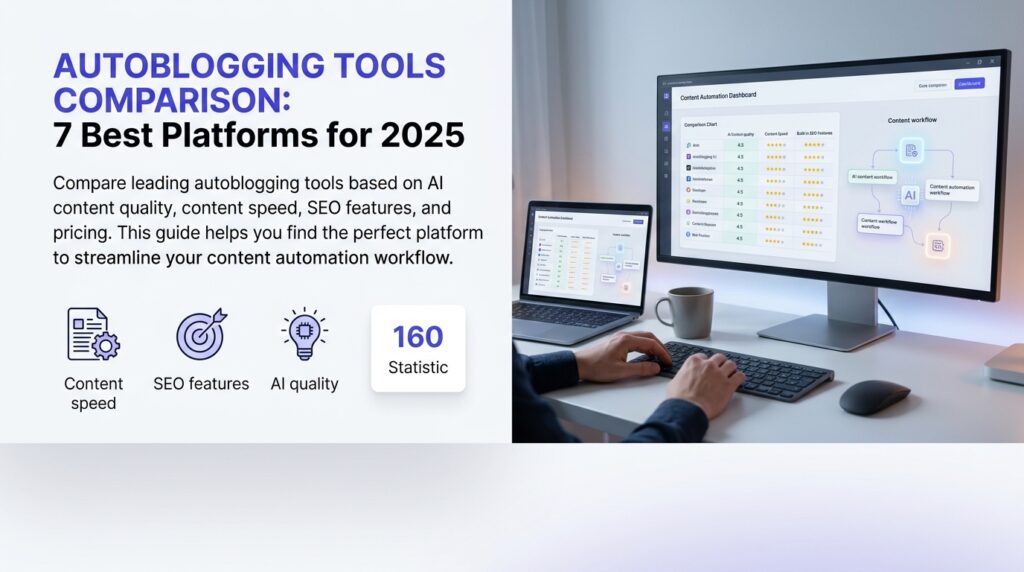
Below is a comparison table showing how leading platforms stack up across the dimensions that matter most to SMBs, agencies, and creators scaling content:
| Platform | AI Quality | Content Speed | SEO Features | Internal Linking | Pricing | Best For |
|---|---|---|---|---|---|---|
| WP BlogPilot | Production-grade | 5-15 min/post | Built-in optimization | Automatic | $29-99/mo | WordPress sites, full automation |
| Jasper | High | 10-20 min/post | Basic keyword research | Manual | $39-125/mo | Creative teams, brand voice control |
| Surfer SEO | Moderate | 15-30 min/post | Advanced ranking signals | Semi-automatic | $89-299/mo | Technical SEO, competitive analysis |
| Copy.ai | Good | 5-10 min/post | Keyword suggestions | Manual | $49-200/mo | Bulk content creation, marketers |
| ChatGPT + Zapier | Variable | 20+ min/post | None (manual) | Manual | $20 + fees | Technical users, DIY workflows |
| Content at Scale | Good | 8-12 min/post | Basic optimization | Manual | $25-99/mo | Budget-conscious creators |
| Semrush WriterAI | Moderate | 15-25 min/post | Strong (SEO OS) | Manual | $99-199/mo | Enterprise teams, brand consistency |
The table shows autoblogging tools comparison winners differ by priority. If you need pure speed with WordPress integration, WP BlogPilot reduces manual steps. If SEO ranking depth matters most, Surfer SEO or Semrush WriterAI pay for themselves through traffic gains. If team brand control is non-negotiable, Jasper offers more customization—at the cost of slower output.
Key Benefits of Running This Comparison First
Primary Advantages
Running a thorough autoblogging tools comparison before committing to one platform delivers measurable returns:
- Time savings: Automation eliminates 10-15 hours per week of manual writing, editing, and scheduling. Teams that integrate autoblogging tools into a WordPress workflow typically cut content cycle time substantially compared to fully manual processes.
- Consistent publishing: Tools like WP BlogPilot maintain publishing cadence even when team availability drops, solving the feast-or-famine content cycle most SMBs face.
- Better SEO outcomes: Platforms with built-in optimization features (keyword insertion, internal linking, meta tag generation) improve rankings faster than manual drafting alone.
- Lower cost per article: At-scale, the cost per piece drops to $5-15 compared to $100-300 for freelance writers, making profitable monetization viable for niche sites and affiliate businesses.
Who Benefits Most
This kind of comparison is most valuable for:
- Solo content operators managing 5+ publications or 50+ pieces per month
- Affiliate site builders scaling topical authority across hundreds of articles
- SaaS companies publishing thought leadership and SEO content without hiring full-time writers
- E-commerce teams generating product descriptions, comparison posts, and buying guides
- Agencies delivering content services to 10+ clients at once
If you publish fewer than 4 articles per month manually, an automation subscription may not justify its cost yet. But the threshold shifts once client demand, SEO opportunities, or funnel scaling pressure emerge.
How to Get Started
Step-by-Step Overview
Starting an autoblogging tools comparison the right way prevents trial-and-error waste:
- Define your workflow: Map out how content moves from ideation to publishing. Do you need WordPress integration? Zapier automation? Internal linking? This clarity narrows platforms immediately.
- Set output benchmarks: How many articles per week do you need? In what time window? Platforms like WP BlogPilot handle 3-5 posts daily; others cap out at 2-3 per week.
- Test free trials: Run 3-5 test pieces through each shortlisted tool. Check AI quality, publish time, SEO readiness, and ease of editing. Most platforms offer 7-14 day free trials.
- Compare outputs directly: Have the same topic written by two or three tools. Compare word count, keyword density, readability scores, and factual accuracy. This reveals quality gaps a data sheet won’t.
- Evaluate integrations: Verify the tool connects to your CMS, analytics platform, and internal linking system. A thorough comparison confirms these integrations work before you commit budget.
Tools and Resources You Need
To run this kind of evaluation effectively, gather:
- 5-10 target topics: Use real keywords from your niche with search intent matching your content strategy.
- SEO audit tool: Semrush or Ahrefs to verify keyword difficulty and competitive content landscape before testing.
- Readability checker: Hemingway Editor or Grammarly to standardize quality assessment across test outputs.
- Tracking spreadsheet: Document output speed, editing time, AI tone consistency, and cost per piece for each tool tested. This quantifies the softer dimensions of the comparison.
Common Mistakes to Avoid
Mistake #1: Choosing Based on Price Alone
The cheapest-looking platform often produces the worst ROI. A $25/month tool that requires 40 minutes of editing per piece will cost more in labor than a $99/month tool outputting publication-ready copy in 15 minutes. Calculate true cost per publishable article, not subscription cost alone.
Mistake #2: Ignoring Integration Friction
Many shoppers overlook the operational cost of manual handoffs. If a tool generates content but requires copy-pasting into WordPress, manual internal linking, and separate SEO optimization, you’ve only automated part of the pipeline. The best platforms in an autoblogging tools comparison eliminate these friction points through native WordPress plugins or one-click publishing workflows.
How to Prevent Them
To avoid these pitfalls, weight your evaluation rubric like this: AI quality (40%), total time to publish including editing and optimization (30%), integration ease (20%), and price (10%). This framework favors efficiency and usability over subscription cost, which better predicts long-term success.
Tips for Getting the Best Results
Pro Tips
- Start narrow, expand wide: In your first evaluation month, focus on one content pillar or niche topic. This creates a repeatable baseline you can scale across other verticals once the workflow is proven.
- Combine platforms strategically: Your best single-platform pick may not excel at everything. Many teams use WP BlogPilot for core publishing automation, then layer Surfer SEO for competitive ranking depth on high-value pieces. Hybrid approaches often beat single-platform strategies.
- Schedule off-peak publishing: Tools that auto-publish allow you to distribute content across prime traffic windows without being online. Test afternoon, evening, and early-morning publish times through analytics to find your audience’s peak engagement window.
- Monitor quality decay: AI output quality can drift over time if the tool uses older training data or if your prompt engineering degrades. Run monthly blind spot checks on 5-10 published pieces to ensure standards haven’t slipped.
Advanced Techniques
Once you’ve settled on a platform from your autoblogging tools comparison, unlock its full potential through:
- Semantic clustering: Group related topics into 3-5 article clusters with automated internal linking. This signals topical authority to search engines faster than random publishing.
- Funnel-aware content generation: Use your tool to generate awareness-stage content at high volume (3-5 per week) while hand-crafting consideration and decision-stage pieces. A side-by-side platform test reveals which tools support bulk awareness-stage work best.
- A/B test headlines and meta: Many autoblogging tools generate multiple headline options. Test top 2-3 variants across your audience to identify which resonate. This amplifies organic click-through rate beyond the baseline AI generation.
Frequently Asked Questions About Autoblogging Tools Comparison
Q: Can autoblogging tools replace writers entirely?
A: No. The best results come from hybrid workflows where AI handles first-draft generation, bulk topical content, and internal link suggestions, while humans handle strategy, fact-checking, and high-stakes sales content. This division of labor maximizes output without sacrificing credibility.
Q: How do I know if AI content will rank?
A: Rank depends on topic competitiveness, backlink profile, and user experience signals—not AI authorship alone. Run your autoblogging tools comparison shortlist against 3-5 low-competition topics in your niche, publish daily for 30 days, then measure traffic gain. This gives you real ranking data for your specific content and audience.
Q: What’s the typical ROI timeline?
A: Most teams see payback within 60-90 days of putting these findings to work generating 50+ articles monthly. Organic traffic growth accelerates at month 4-6 as topical authority builds. If you’re not seeing measurable traffic uplift by month 4, the issue is usually strategy (keyword selection, internal linking, or promotion), not the tool itself.
Q: Should I use one tool or combine multiple?
A: Testing only single-platform workflows often misses hybrid efficiency gains. Many profitable operations use a core publishing tool (like WP BlogPilot for WordPress automation) plus a specialized SEO platform for competitive analysis and ranking optimization. This approach costs more upfront but scales faster.
Your autoblogging tools comparison doesn’t end with platform selection—it evolves as your content strategy matures. Revisit this analysis quarterly to ensure your tool still matches your workflow, volume targets, and quality standards. The best platform today may not be best for you next year as your funnel and audience expand.
Still deciding? We can help. Try it free — no credit card required.
Stop choosing between manual blogging and mediocre AI. WP BlogPilot automates your entire content pipeline with production-grade quality—start your free trial now.
Get new posts by email
Pick the topics you care about — we only email you when something new is published in them.