
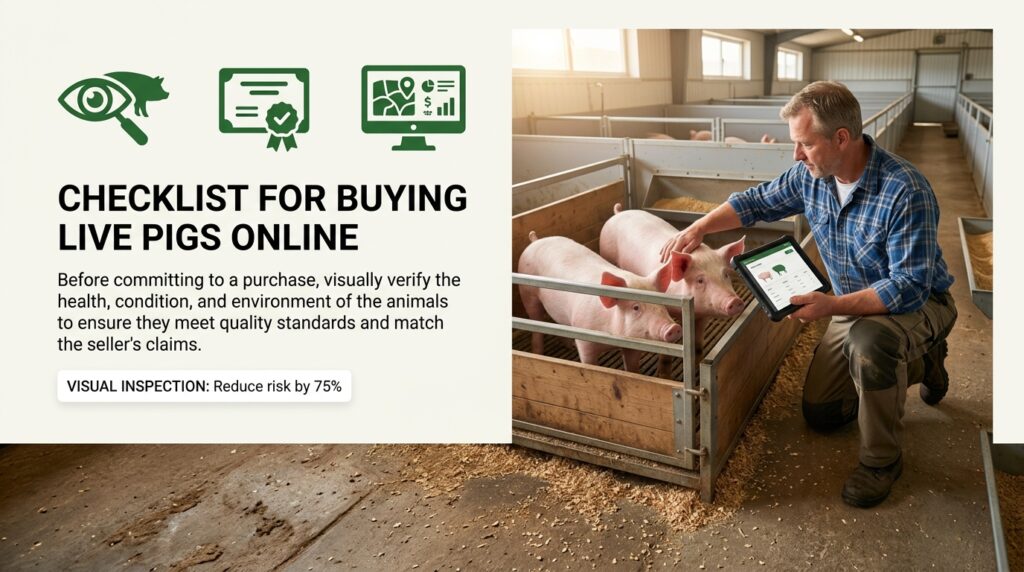
Knowing what to check before buying live pigs online is one of the most practical skills a smallholder farmer can develop. Online livestock marketplaces have made it easier than ever to source breeding stock, weaners, or fatteners from across a region — but that convenience comes with real risks if you skip the right verification steps. A single sick pig introduced to your herd can wipe out months of profit, and a fraudulent seller can take your deposit and disappear. This guide gives you a clear, structured approach to every check that matters. That checklist is what to check before buying live pigs online, in the order that actually protects your herd.
What to Check Before Buying Live Pigs Online: Definition and Background
Definition and Background
Buying live pigs online means sourcing animals through digital channels — livestock marketplaces, social media groups, agricultural e-commerce platforms, or direct seller websites — rather than attending a physical auction or walking through a farm in person. The practice has grown steadily across Southeast Asia, sub-Saharan Africa, and South Asia, where smallholders increasingly use smartphones to reach sellers outside their immediate area. That shift in how farmers shop is exactly why what to check before buying live pigs online has become its own skill.
The verification process refers to the set of checks a buyer performs before making payment or arranging transport. These checks span animal health, seller credibility, legal compliance, and logistics. Unlike buying from a neighbour whose farm you can visit, online transactions compress your information window significantly — you are often working from photos, video calls, and written claims alone. That compressed information window is exactly why knowing what to check before buying live pigs online matters so much.
Disease pressure makes this even more consequential. African Swine Fever (ASF) continues to affect herds across Asia and parts of Europe, and hog markets in regions like Negros Oriental in the Philippines have seen price controls introduced specifically because ASF outbreaks disrupted local supply chains. Buying an exposed animal online and transporting it across district or provincial lines is one of the fastest ways to spread a disease to a previously clean farm.
Why It Matters
The financial stakes are straightforward. Replacement costs, veterinary bills, and lost production time following a disease introduction can far exceed the price of the original pigs. Beyond your own farm, introducing a notifiable disease affects your neighbours, your community’s livestock value, and your ability to sell animals in the future. Doing the checks properly protects your investment and your reputation as a responsible farmer. Knowing what to check before buying live pigs online is what separates that outcome from a costly one.
Key Benefits of Knowing What to Check Before Buying Live Pigs Online
Primary Advantages
Applying a structured checklist to check before buying live pigs online gives you several concrete advantages. First, it filters out low-quality sellers quickly — a legitimate breeder has no problem providing health certificates, vaccination records, or a live video walkthrough of the animals. A fraudulent or careless seller stalls, makes excuses, or disappears.
Second, it gives you negotiating power. When you arrive at a transaction knowing exactly what documentation you need and what red flags look like, you negotiate from knowledge rather than hope. You can push back on inflated prices for animals that lack proper records, or walk away without regret when something does not add up. That instinct is really just applied knowledge of what to check before buying live pigs online.
Third, systematic pre-purchase checks create a paper trail. If an animal arrives sick and you have the seller’s health certificate and photo evidence of the condition at dispatch, you have a basis for a claim. Without that documentation, you have very little recourse.
According to the FAO’s pig sector overview, smallholder pig farming supports the livelihoods of millions of households globally, making sound purchasing decisions a foundational part of farm resilience — not just a nice-to-have precaution. Learning what to check before buying live pigs online is, in that sense, part of basic farm resilience.
Who Benefits Most
Any farmer buying stock remotely benefits, but those expanding their herd for the first time or sourcing from a new region benefit most. If you are building a breeding programme, the genetic quality and health baseline of your foundation stock will shape your results for years. Getting that initial purchase right is disproportionately valuable.
Farmers in areas with active disease alerts — whether ASF, Foot and Mouth Disease, or Porcine Reproductive and Respiratory Syndrome (PRRS) — also gain the most from thorough pre-purchase checks, since the consequences of a wrong decision are higher where disease pressure already exists. In those higher-risk regions, what to check before buying live pigs online matters even more than usual.
How to Get Started: Step-by-Step Checks Before Buying Live Pigs Online
Step-by-Step Overview
Follow these steps in order. Skipping ahead or treating them as optional undermines the whole process.
- Verify the seller’s identity and location. Request a government-issued ID, a business registration number if they operate commercially, and confirmation of their physical address. Cross-reference the address on Google Maps or a local mapping tool. Ask for a live video call showing the farm — not pre-recorded footage.
- Request current health certificates. A legitimate seller can provide a veterinary health certificate issued within the last 30 days. The certificate should state the animals are free from notifiable diseases and list the vaccinations administered, including dates.
- Check vaccination records individually. Ask for records per animal, not just a batch statement. Key vaccines to confirm include those for Classical Swine Fever (CSF), erysipelas, and any regionally relevant diseases. Cross-check dates against the pig’s stated age — a weaner supposedly vaccinated six months ago raises questions if it is only eight weeks old.
- Request a live video inspection of each animal. Look for clear eyes, normal gait, absence of skin lesions, and a body condition score appropriate for the animal’s age and breed. Ask the seller to show you the pen, the water and feed access, and the overall farm hygiene. A clean, well-managed operation is visible even on a smartphone camera.
- Confirm movement permits and transport compliance. Most jurisdictions require a movement permit before livestock crosses administrative boundaries. Ask to see the permit template or confirm the seller’s process for obtaining one. Understand your own region’s import requirements before you agree to a purchase.
- Clarify weight and age verification. Ask for a weighbridge ticket or a recent weigh-in record. If the seller cannot provide one, request that the animals be weighed on a certified scale at dispatch, with a photo of the reading beside the animal.
- Agree on payment terms and dispute resolution in writing. Use a written agreement — even a simple message thread screenshot can serve as evidence. Avoid full upfront payment to unknown sellers. A 50% deposit with balance on delivery is a common and fair structure.
Tools and Resources You Need
A smartphone with a good camera handles the video inspection. A reliable messaging app with photo and document sharing — WhatsApp, Telegram, or Viber — lets you request and store documentation. Keep a dedicated folder for each transaction with all photos, certificates, and written agreements saved. That folder is a practical, physical answer to what to check before buying live pigs online.
For tracking the animals after they arrive, PigPal lets you log each pig’s arrival weight and health status from your phone, giving you a clean record from day one that continues through the animal’s entire production cycle.
Your national or regional veterinary authority’s website is also essential — it will list current disease alerts, movement permit requirements, and approved testing laboratories. In our experience working with smallholder farmers across multiple markets, the farmers who reference these official resources before a purchase make significantly fewer costly errors than those who rely solely on the seller’s word. Their habits show exactly what to check before buying live pigs online looks like in daily practice.
Common Mistakes to Avoid When Buying Live Pigs Online
Mistake #1: Buying on Price Alone
The most frequent mistake farmers make when sourcing online is selecting the lowest-priced animals without investigating why the price is low. A weaner priced 30% below the local market average is not a bargain if it carries a subclinical respiratory infection or comes from a farm in an ASF surveillance zone. The teacup pig phenomenon — where sellers market small pigs as a novelty breed at premium prices, only for buyers to discover they simply bought a malnourished standard pig — is a different version of the same trap: the listing does not match reality.
Price should be one data point among many, not the deciding factor. Know your local market rate for the class of animal you are buying, and treat significant deviations in either direction as a reason to ask more questions, not fewer. Treating price as one signal among many is a core part of what to check before buying live pigs online.
Mistake #2: Skipping the Quarantine Period
Even when every document checks out, newly purchased pigs should spend a minimum of 21 to 28 days in a quarantine pen away from your existing herd. Biosecurity protocols for pig farms consistently identify the introduction of new animals without quarantine as one of the primary entry points for disease. During this period, observe the new animals daily for signs of respiratory distress, skin changes, lameness, or reduced appetite.
Farmers who skip quarantine because the animals “look fine” are taking a risk that a 30-day waiting period almost completely eliminates. The short-term production gain of faster integration is not worth the potential loss of your entire herd. Patience during quarantine is one more piece of what to check before buying live pigs online before you relax.
For more on avoiding the kinds of losses that follow poor purchasing decisions, the guide on pig farming losses and how to avoid them covers the full picture of herd-level risk management for smallholders.
How to Prevent Them
Build a simple pre-purchase checklist and use it without exception. Treat every online purchase as if you are a first-time buyer — complacency tends to set in after a few successful transactions, and that is exactly when sellers with something to hide have an easier time. Share your checklist with any farm employee or family member who might handle a purchase in your absence. A shared checklist keeps everyone aligned on what to check before buying live pigs online, not just the primary buyer.
Tips for Getting the Best Results
Pro Tips
Reach out to other farmers who have bought from the same seller before making your own purchase. Online livestock groups and farming cooperatives often have informal reputation networks — a seller known for healthy, accurately described animals will have repeat buyers willing to vouch for them. A seller who cannot provide a single reference from a previous buyer is a warning sign.
Time your purchase to avoid disease seasonality in your target region. Some respiratory conditions peak in the cooler months; stress from transport compounds the risk. If you are buying during a period of elevated disease activity in the source region, either delay or apply a longer quarantine period than usual. Adjusting for seasonality is a less obvious part of what to check before buying live pigs online, but a real one.
Document the animals’ condition at arrival with dated photos and video. If a dispute arises later, this timestamp evidence is far more persuasive than a written description alone.
Advanced Techniques
For larger purchases — say, ten or more animals — consider hiring a local veterinarian or trusted agent in the seller’s region to perform an in-person pre-purchase inspection on your behalf. The cost of a professional inspection fee is trivial compared to the cost of buying a batch of compromised stock. This approach is standard practice among commercial operations and increasingly accessible to smallholders as veterinary services expand in rural areas. A paid inspection is simply what to check before buying live pigs online, done by someone with trained eyes.
Establish a relationship with a local bank or mobile money platform that offers escrow-style payment holding. Rather than sending a deposit directly, the payment sits in a held account and releases to the seller only when you confirm the animals have arrived in the described condition. This structure protects both parties and tends to attract more credible sellers.
Track the performance of every animal you purchase against your pre-purchase claims. If a seller told you a gilt would reach 90 kg in 14 weeks and she reaches it in 18, that is useful intelligence for your next purchase decision. Apps like PigPal make this kind of weight-gain tracking straightforward, and over time the data helps you identify which sources consistently deliver what they promise. For further context on how poor sourcing decisions affect farm profitability, the breakdown of reasons pig farms become unprofitable is worth reading alongside this guide. Tracking outcomes against claims is the follow-through half of what to check before buying live pigs online.
Frequently Asked Questions About What to Check Before Buying Live Pigs Online
What documents should a seller provide before I pay?
At minimum, request a veterinary health certificate issued within the last 30 days, individual vaccination records, and the seller’s government-issued identification. If the animals will cross administrative boundaries, also ask for proof that a movement permit will be arranged before transport begins. Confirming that permit in advance is a small but essential part of what to check before buying live pigs online.
How do I assess pig health through a video call?
Ask the seller to show each animal standing and walking. Look for alertness, clear eyes without discharge, smooth skin without redness or lesions, normal posture, and a body condition that matches the stated age and breed. Ask them to show the water and feed stations and the general cleanliness of the pen. A well-lit, unhurried walkthrough is a reasonable request — resistance to showing you these things is itself informative. A seller’s willingness to show you these things is a direct test of what to check before buying live pigs online.
What is the quarantine period for newly purchased pigs?
A minimum of 21 days is the standard recommendation from most veterinary authorities, with 28 days offering a wider safety margin for diseases with longer incubation periods. Keep new animals in a separate pen with separate feeding and watering equipment, and wash hands and change footwear before moving between the quarantine area and your main herd.
Are there reliable online platforms for buying live pigs?
Platform quality varies significantly by country and region, and named platforms change often enough that a name check is worth doing yourself before you rely on one. In the Philippines, local provincial Facebook livestock groups remain the most commonly used channel. In India, Animall is a well-established online trading platform, but it is built for cattle and buffalo, not pigs — check what a platform actually lists before assuming it covers swine. Regardless of the platform, the verification steps described in this guide apply equally — the platform itself does not substitute for your own due diligence. No platform substitutes for what to check before buying live pigs online yourself — that responsibility stays with the buyer.
What are the biggest red flags when buying pigs online?
The clearest red flags include: refusal to provide veterinary documentation, reluctance to do a live video call, prices substantially below the regional market rate, pressure to pay the full amount upfront via an untraceable method, and inability to provide references from previous buyers. Any single one of these warrants caution; multiple flags together should end the conversation.
How do I record the new pigs’ data after they arrive?
Log each animal’s arrival date, weight, age, breed, and vaccination history immediately. Record the seller’s name, the purchase price, and the source region. This baseline data lets you track growth performance and calculate the true cost per kilogram at slaughter or sale. A farm management app keeps all of this in one place instead of scattered across paper and messaging threads — which is particularly useful during the high-attention quarantine period when you are monitoring multiple new animals simultaneously. Good records at this stage are the last practical step in what to check before buying live pigs online.
Take the next step: Try it free — no credit card required.
Manage Your Pig Farm from Your Phone PigPal makes farm management simple — track breeding cycles, feed costs, and pig weights, all in one app designed for small and commercial pig farmers. Get PigPal Free →
More in this series
Get new posts by email
Pick the topics you care about — we only email you when something new is published in them.