
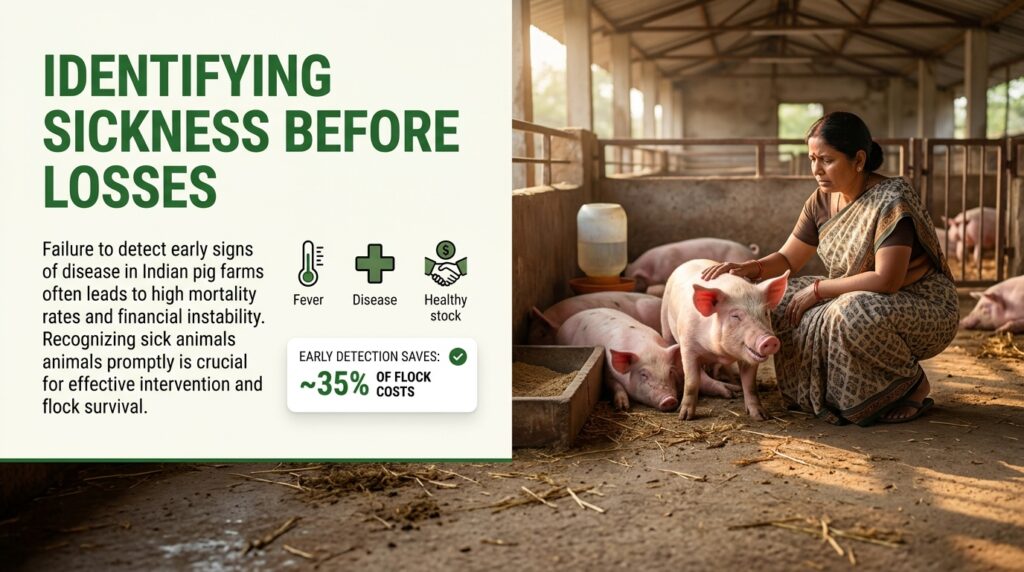
Understanding why pig farms fail in India is the first step toward building one that lasts. Thousands of smallholder pig farmers across India enter the industry with real investment, genuine effort, and high hopes — yet a significant portion exit within three years. The failure patterns are consistent, and they are largely avoidable. Before you can protect your farm’s profitability of pig farming, you need to understand exactly where and why things go wrong. Answering why pig farms fail in India clearly is the goal of everything that follows.
This guide examines the structural and operational reasons pig farms fail in India, drawing on documented patterns and data from across the sector. Whether you are a new farmer or someone managing an established unit, the patterns below apply directly to your situation. For a deeper look at income and expense benchmarks, the profitability of pig farming guide gives you the numbers to work from. The numbers alone will not tell you why pig farms fail in India — the patterns below will.
Why Pig Farms Fail in India: The Core Problem Defined
Definition and Background
When we say pig farms fail in India, we mean the farm stops generating enough revenue to cover operating costs and loan repayments, forcing the farmer to sell the herd, abandon the unit, or absorb sustained personal losses. This is distinct from a single bad season. Farm failure is a structural collapse — the business model stops working because one or more foundational inputs are broken.
India’s pig population sits at roughly 9.06 million animals according to the Department of Animal Husbandry and Dairying’s 20th Livestock Census, yet per-animal productivity and farm longevity remain well below potential. States like Meghalaya, Nagaland, Manipur, and Assam carry most of the population, with pork consumption deeply embedded in local food culture. Despite this demand, farm attrition rates remain high because supply-side management is weak.
Why It Matters
Farm failure is not just a financial event — it wipes out multi-year investments, disrupts household income, and leaves rural families in debt. In Northeast India especially, pig farming supports tribal livelihoods and women’s economic participation. Research published in Frontiers in Nutrition highlights that sustainable pork production and processing has real potential to empower tribal women economically in Northeast India — but that potential evaporates when farms collapse due to preventable mismanagement. Understanding why pig farms fail in India protects not just profit margins, but entire family economies.
The 6 Root Causes Behind Most Farm Failures
Primary Advantages of Knowing These Causes
Knowing the exact failure points gives you a diagnostic framework. Instead of reacting to problems after they cost you money, you can build systems that catch warning signs early. Each of the six causes below has a direct counter-measure that working farms use consistently. Together, these six causes explain why so many farms in India don’t survive.
- Disease outbreaks with no vaccination protocol. African Swine Fever (ASF) and Classical Swine Fever (CSF) are the most devastating. ASF has no vaccine and carries near-100% mortality in infected herds. The FAO’s ASF situation updates for Asia and the Pacific track ongoing outbreaks in the region, and India’s northeastern states are widely documented as a high-risk entry point given the porous border with Myanmar and China. Farms with no biosecurity protocol and no vaccination record for CSF are the first to collapse when disease enters a district.
- No financial records or feed cost tracking. Feed typically accounts for 65–75% of total pig production costs. When farmers buy feed reactively rather than by a planned budget, costs spiral undetected. Without a running cost-per-kilogram figure, it is easy to keep pricing piglets and finished pigs below the actual break-even point without realising it.
- Poor breeding management. Untracked farrowing cycles, unrecorded litter sizes, and failure to cull low-performing sows drag down herd productivity year after year. A sow producing fewer than eight piglets per litter consistently is reducing farm revenue without the farmer necessarily realising it.
- Market dependency without buyer diversification. Many smallholder farms in India sell exclusively to a single local trader at whatever price is offered on slaughter day. When that trader drops prices or disappears, the farm has no alternative channel and is forced to sell at a loss or hold animals beyond optimal slaughter weight — increasing feed costs further.
- Inadequate housing and waste management. Poorly designed pens increase stress, disease transmission, and mortality rates. Waste management failures attract complaints, legal notices, and biosecurity breakdown. Farms that fail often have pens built without drainage, no separation of sick animals, and no cleaning schedule.
- No access to veterinary support or extension services. Remote farms often go weeks between veterinary visits. By the time a disease or nutritional deficiency is diagnosed, losses are already severe. Farms that survive long-term have either a reliable vet relationship or a farmer-managed health monitoring system that flags problems early.
Who Benefits Most from Understanding These Causes
New entrants benefit most, because they can build the right systems before bad habits form. But farmers with two to five years of experience also gain — many are operating on intuition and surviving rather than growing, and understanding these failure causes shows them exactly where they are leaving money on the table or carrying hidden risk. Recognising these patterns early pays off at any stage of experience.
How to Get Started Fixing the Problems That Make Pig Farms Fail
Step-by-Step Overview
Addressing the reasons pig farms fail in India does not require rebuilding your entire operation at once. Work through these steps in order:
- Step 1 — Audit your current records. Write down every pig on your farm, its age, weight (if known), and health status. If you cannot do this in under an hour, your record-keeping is the first thing to fix. See our guide on pig farm not profitable reasons for a detailed breakdown of how poor records hide losses.
- Step 2 — Create a vaccination calendar. Work with your local veterinarian to establish a minimum vaccination schedule for CSF, FMD (if applicable), and any region-specific diseases. Record every dose given, the product name, and the date. This alone separates farms that survive disease pressure from those that do not.
- Step 3 — Calculate your actual feed cost per pig per day. Track every feed purchase for 30 days. Divide total spend by total pig days. This number tells you your minimum daily cost of keeping each animal alive — and reveals whether your selling price makes sense.
- Step 4 — Record every farrowing event. Note the sow, date, litter size, number of live piglets, and piglet weights where possible. After three farrowing cycles you will have enough data to identify your best and worst-performing sows.
- Step 5 — Identify at least two buyers. Even if you sell 90% of your pigs to one trader, having a second contact — a local processor, restaurant, or market — gives you leverage and a safety net.
- Step 6 — Implement a basic biosecurity protocol. Foot dips at pen entry, quarantine of new animals for 14 days, and a cleaning schedule are the minimum standards that separate farms with controlled disease from those that experience regular outbreaks.
Tools and Resources You Need
A physical ledger works better than nothing, but it has obvious limits — it can be lost, it does not calculate averages, and it cannot send reminders. PigPal is a piggery management app built specifically for smallholder farmers that tracks breeding cycles, vaccination schedules, feed costs, and pig weights from a phone. For farmers who struggle with record-keeping discipline, having everything in one place on a device they already use daily removes the main barrier. Beyond software, access to a good veterinarian, a reliable feed supplier, and a basic weighing scale are the three physical resources that separate functional farms from struggling ones. Better record-keeping will not fix every problem on this list, but it removes one major blind spot.
Common Mistakes That Make Failure More Likely
Mistake #1: Treating Pig Farming as a Passive Investment
Some farmers — particularly those who start with a government subsidy or a small loan — treat their pig unit as a set-and-forget operation. They purchase breeding stock, arrange basic feed supply, and then check in occasionally. Pigs require daily observation. Changes in appetite, gait, skin condition, and social behaviour are early indicators of health problems. Farmers who are not present and attentive daily miss these signals until the problem is serious enough to cause mortality or require expensive veterinary intervention. This is one of the most consistent patterns behind farm failure at scale.
Mistake #2: Borrowing to Scale Before Proving Profitability
Expanding from 10 pigs to 50 pigs sounds like growth. But if your cost per kilogram of liveweight gain is higher than your selling price, scaling multiplies your losses rather than your profits. Farmers who take loans to expand before they have a verified break-even calculation are the most vulnerable to farm failure. The debt servicing cost alone can sink an operation that was previously just barely surviving on thin margins. Debt taken on too early is one of the clearest ways a promising farm collapses.
How to Prevent These Mistakes
Daily farm walks — even 15 minutes each morning — create the observational habit that catches problems early. For scaling decisions, use a simple rule: only expand when your current unit has produced net profit for two consecutive farrowing cycles. Track your cash flow carefully during those cycles so you understand your actual margins, not just your gross revenue.
Tips for Getting the Best Results from Your Pig Farm
Pro Tips
- Weigh piglets at birth, at weaning, and at 60-day intervals. Weight gain data is the single most reliable indicator of feed efficiency and herd health combined.
- Join a local pig farmers’ cooperative or self-help group if one exists in your district. Collective buying reduces feed costs; collective selling gives you better market leverage.
- Integrate crop residues and kitchen waste into your feed mix strategically — not randomly. Know the energy and protein value of each ingredient so you do not create nutritional deficiencies by accident.
- Keep a photograph record of each pig alongside your written records. Visual documentation helps vets diagnose problems remotely and gives you evidence if you need to make an insurance or subsidy claim.
Advanced Techniques
Integrated farming — combining pig production with fish ponds, vegetable gardens, or biogas generation — is gaining traction across Northeast India as a way to reduce waste disposal costs and generate additional income streams. Integrated pig-fish farming, where pig waste feeds the pond and pond silt fertilises the vegetable plot, is a documented practice on smallholder farms in states like Manipur, turning a disposal problem into a second income stream. This kind of integration does not eliminate the management discipline required for the pig unit itself, but it changes the economics of failure: even if pig prices drop, the farm is not entirely exposed. Diversifying income this way softens the risk of relying on pig prices alone — though it does not eliminate it.
For breeding management, crossing local breeds with improved exotic breeds like Large White or Landrace can raise litter sizes and growth rates significantly — but only when nutrition and housing keep pace with the higher physiological demands of improved genetics. Upgrading genetics without upgrading management is a common reason pig farms fail in India at the production quality level rather than the disease level.
Frequently Asked Questions About Pig Farm Failure in India
Why do pig farms fail in India more often than poultry farms?
Pig farming in India has weaker institutional support than the poultry sector. Poultry integrators provide feed, chicks, and a guaranteed buyback — removing market risk from the farmer. Pig farmers typically operate independently with no such safety net, making feed cost management, disease control, and market access all their own responsibility simultaneously. That missing safety net is a large part of the gap between the two sectors.
Is African Swine Fever the main reason pig farms fail in India?
ASF is a catastrophic cause of failure when it hits, but it is not the most common reason farms close. Poor financial records, uncontrolled feed costs, and weak breeding management account for more cumulative farm failures than disease alone. ASF gets attention because the losses are sudden and dramatic — but slow financial erosion kills more farms over time. See our detailed breakdown of how to avoid pig farming losses for a step-by-step approach to the financial side. Slow financial erosion, not disease alone, is usually the bigger culprit over the long run.
Can a farm recover after a disease outbreak?
Yes, but recovery requires capital, time, and a genuine biosecurity upgrade before restocking. Farmers who restock immediately after an outbreak without changing their management practices typically experience a second outbreak within 12–18 months. A recovery plan needs to include a full pen cleanout and disinfection, a waiting period of at least 4–6 weeks before new animals enter, and a written biosecurity protocol that everyone on the farm follows. Skipping that discipline is what causes a second, preventable collapse after an outbreak rather than during one.
What record-keeping system works best for small pig farms?
Consistency matters more than complexity. A simple notebook used daily beats an elaborate system used once a week. That said, app-based tools like PigPal automate reminders and calculations that manual systems miss, which is particularly useful for vaccination scheduling and tracking cost per pig. For a comparison of digital versus manual approaches, the guide on how to know if your pig farm is profitable covers the key metrics to track regardless of which system you use. Whichever system you choose, consistent use is what actually prevents the failure patterns covered here.
How long does it take to make a pig farm profitable in India?
With good management, correct breed selection, and stable market access, most smallholder farms reach operational break-even within the first or second farrowing cycle — roughly 6 to 10 months. Consistent net profit, covering loan repayments and owner income, typically requires 18–24 months of disciplined operation. Farms that try to shortcut this timeline by cutting corners on feed quality or veterinary care almost always extend the unprofitable period rather than reducing it.
Take the next step: Try it free — no credit card required.
Manage Your Pig Farm from Your Phone PigPal makes farm management simple — track vaccinations, breeding cycles, feed costs, and pig weights all in one app designed for small and commercial pig farmers. Get PigPal Free →
More in this series
Get new posts by email
Pick the topics you care about — we only email you when something new is published in them.