
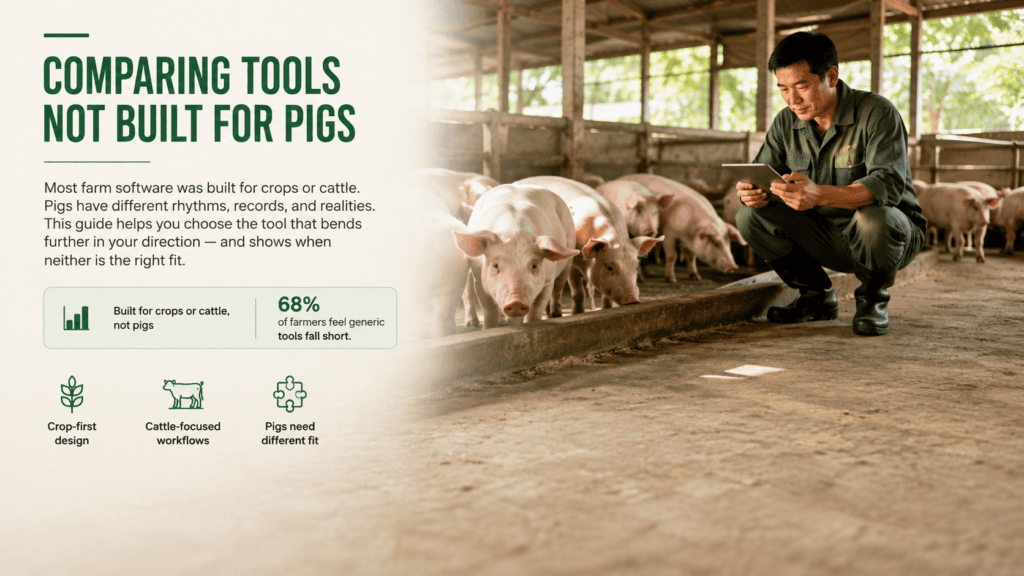
Comparing farm software for a pig farm usually means comparing two tools that were built for something else. Agworld is a crop and agronomy platform. Herdwatch is a livestock platform built around cattle and sheep. Both are real, established products with genuine strengths — and neither was designed with pigs at the centre. This comparison is about which one bends more usefully in your direction, and when the honest answer is “neither.”
How this comparison was written: from both companies’ published product, pricing and integration pages, plus app store listings, checked in August 2026. We have not run paid subscriptions to either platform on a working pig farm, so there are no invented test results, timings or star scores here. Where a figure comes from a third-party directory rather than the vendor, we say so.
Quick Comparison: Agworld vs Herdwatch
| Feature | Agworld | Herdwatch |
|---|---|---|
| Built for | Crops and agronomy | Livestock, mainly cattle and sheep |
| Pig records | None natively; livestock via Mobble integration | Yes — pigs supported alongside cattle and sheep |
| Organising unit | The field | The animal |
| Offline mobile | Full offline capture and sync (iOS and Android) | Full offline capture and sync (iOS and Android) |
| Medicine records | Chemical applications only, not animal treatments | Treatment records with barcode medicine scanning |
| Breeding tracking | Not applicable | Breeding and calving/lambing focused; limited for farrowing |
| Compliance focus | Spray records, labels and SDS | EU and UK animal movement and medicine regulation |
| Financials | Gross margin by field and crop | Basic sales, purchases and feed records |
| Pricing model | Annual tiers, prices not published on site | Free tier plus paid plans from around €99/year |
| Free trial | 7 days, then read-only | Free plan available |
| Best for | Growers with an agronomist | Cattle and sheep farmers in the EU/UK |
Agworld: A Crop Platform, Honestly Described
Agworld was founded in Perth, Australia in 2009 and has been owned by Canada’s Semios since August 2021, in a deal reported at over $100 million. It now sits in Semios Group alongside Greenbook and Altrac. It describes itself as a collaborative farm data ecosystem for growers and agronomists, and that description is accurate to the point of being the whole review.
The feature set is agronomic throughout: field mapping, compliant spray and application records, chemical label and SDS access, tank mix calculation, planning and budgeting, gross margin reporting by field and crop, NDVI imagery, work orders, and harvest yields. The integrations confirm it — John Deere Operations Center, CNH FieldOps, Slingshot, Satamap, PCT Agcloud, Power BI, and grain storage and machinery maintenance tools from FarmReady.
Where livestock actually lives in Agworld
Agworld has no native livestock module. There is no animal record, no treatment log, no breeding entry. What exists is an integration with Mobble, a separate livestock app, listed on Agworld’s pricing page as “Connect with Mobble.” Mobble holds the animal data; Agworld displays some of it on the farm map — paddock grazing duration, days rested, stocking rates, mob age, groups and classes.
Look at those fields and the intent is obvious: grazing and rotation context for a mixed cropping and grazing farm. If your pigs are in pens or sheds rather than moving through paddocks, almost none of it applies.
Offline access: a strength, not a weakness
Worth correcting a common claim: Agworld’s offline capability is genuinely good and has been a headline feature since its early iPad days. You capture data in the field with no signal and it syncs when you reconnect, on both iOS and Android. Anyone telling you Agworld is online-only or restricted to read-only offline views is wrong. On this specific point the two platforms are evenly matched.
Herdwatch: Livestock-First, But Cattle-Shaped
Herdwatch is an Irish livestock management app used on tens of thousands of farms across Ireland, the UK and beyond. Unlike Agworld, its organising unit is the animal. You open it and see animals, treatments and compliance, not paddock diagrams.
It supports cattle, sheep and pig record-keeping, works offline with sync on reconnect, pairs with Bluetooth EID readers and weigh heads, and records feed purchases, weaning, sales and purchases. Its standout feature is the medicine barcode scanner: point your phone camera at a medicine bottle, the app identifies the product and its regulatory number, you pick the animal, and the record is audit-ready.
The caveats a pig farmer should know
- It is cattle and sheep software that also handles pigs. The solution pages, the marketing and the depth are built around cattle, dairy, sheep and pasture. Pigs are supported, not specialised in.
- The compliance value is regional. Herdwatch’s biggest advantage is direct integration with EU and UK regulatory systems for animal movements and medicine records. If you farm outside those jurisdictions, a large part of what you’re paying for doesn’t apply to you.
- Breeding is calving-shaped. The breeding tooling is built around cattle and sheep cycles. Farrowing intervals, litter records and weaning batches are not the design centre.
- It is not farm accounting. There are sales, purchase and feed records, but it isn’t a bookkeeping system.
Pricing
Agworld sells three grower tiers — Basic, Plus and Pro — plus Enterprise by enquiry. Its own pricing page lists features but not prices; you go through sign-up or contact sales, and rates vary by region. Third-party directories such as Capterra have listed the US plans as flat annual subscriptions in the region of $1,495, $2,495 and $3,995 per year. Treat those as indicative and confirm before budgeting. There’s a 7-day full-access trial, after which the account becomes read-only.
Herdwatch publishes pricing more openly and is substantially cheaper. There’s a limited free plan, with paid plans reported to start around €99 per year, varying by country and herd size. For a smallholder the difference is not marginal — it’s the difference between a low four-figure annual commitment and something under a hundred euro.
Which One Should a Pig Farmer Choose?
Three questions settle it.
- Is cropping what decides whether your year is profitable? If yes, Agworld is a strong choice for the crop side — and you should keep the pig records somewhere else entirely.
- Do you farm in the EU or UK and need compliant medicine and movement records? If yes, Herdwatch’s regulatory integrations are the single best reason to pick it.
- Are pigs the whole business? If yes, neither platform is aimed at you, and the comparison matters less than you’d think.
Between the two, for anyone whose farm is mainly animals, Herdwatch is the better fit and the cheaper one. Agworld only wins when crops are the main event. But the more useful conclusion is that a comparison between a crop platform and a cattle platform is a poor way to choose pig software.
What Pig Farmers Usually Need Instead
The records that actually run a piggery: which pigs you have and what they weigh, when each was last vaccinated or dewormed, which sow was served and when she’s due, what the feed cost, and whether the farm made money.
For production analytics and industry benchmarking on a commercial sow herd, PigCHAMP is the established option. PigPal is our own app, aimed at the smallholder end — per-pig profiles, a visual family tree with an inbreeding check, vaccination and deworming records, feed tracking, farm accounting, and a marketplace for buying and selling. It works offline and is free on Google Play, Android only. We make it, so weigh this accordingly: PigPal is a phone-first tool for running a small pig farm, and neither Agworld nor Herdwatch is trying to be that.
Frequently Asked Questions
Does Agworld track pigs?
Not natively. Livestock data comes from the separate Mobble app via an integration that shows mob-level grazing and paddock information on your Agworld map.
Does Herdwatch support pigs?
Yes, alongside cattle and sheep. But the platform’s depth, and its regulatory integrations, are built around cattle and sheep.
Which one works better offline?
Both capture data offline and sync on reconnect, on iOS and Android. This isn’t a differentiator between them.
Which is cheaper?
Herdwatch, by a wide margin. It has a free plan and paid plans reported from around €99/year. Agworld’s plans are annual and, per third-party listings, in the $1,495–$3,995 range.
Can either handle farrowing and litter records?
Agworld, no. Herdwatch records pig events but its breeding tooling is shaped around calving and lambing rather than farrowing intervals and litter performance.
Do either do farm accounting?
Agworld does gross margin by field and crop, which is real financial reporting but crop-shaped. Herdwatch records sales, purchases and feed but isn’t a bookkeeping system.
Built for pigs, not adapted from cattle
PigPal tracks farrowing, vaccinations, breeding cycles, feed costs and pig weights, with bloodline records and full farm accounting built in. Works offline. Free to download on Google Play.
More in this series
Get new posts by email
Pick the topics you care about — we only email you when something new is published in them.