
Hercules AI App Builder Review: We Built Two Real Apps and Read Every Line of Code
This post contains an affiliate link — see the disclosure below.
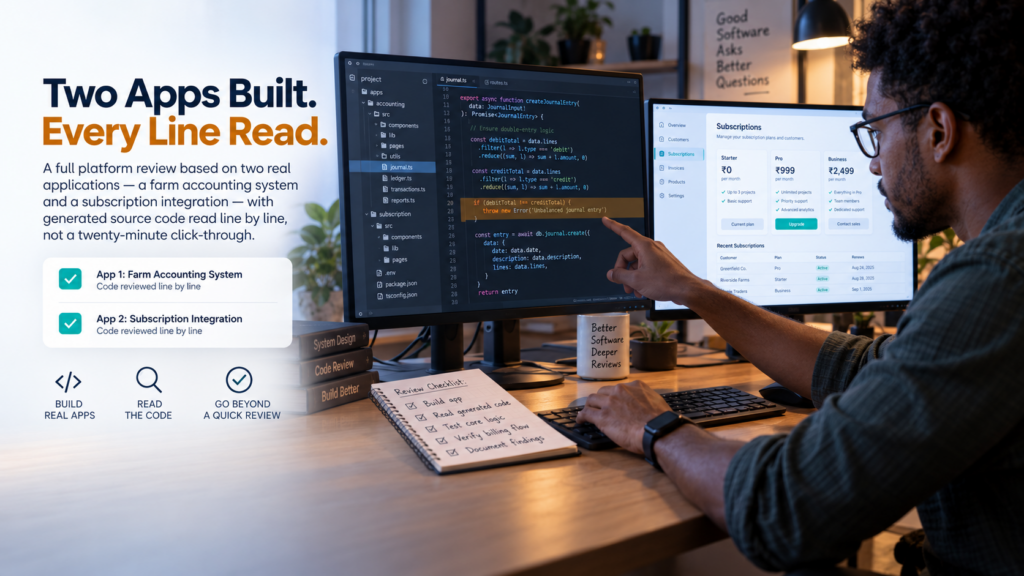
Most AI app builder reviews are written after twenty minutes of clicking around. This Hercules AI app builder review isn’t one of them — we built two full applications on Hercules and read the generated source code line by line: a farm accounting system with real double-entry logic, and a complete Stripe subscription integration.
Here’s the short version of this Hercules AI app builder review: Hercules is unusually good at the things that get other platforms breached, and it makes the same class of quiet correctness mistakes every AI builder makes. Whether that’s a good trade depends entirely on what you’re building and whether anyone is reviewing the output.
What Hercules Actually Is
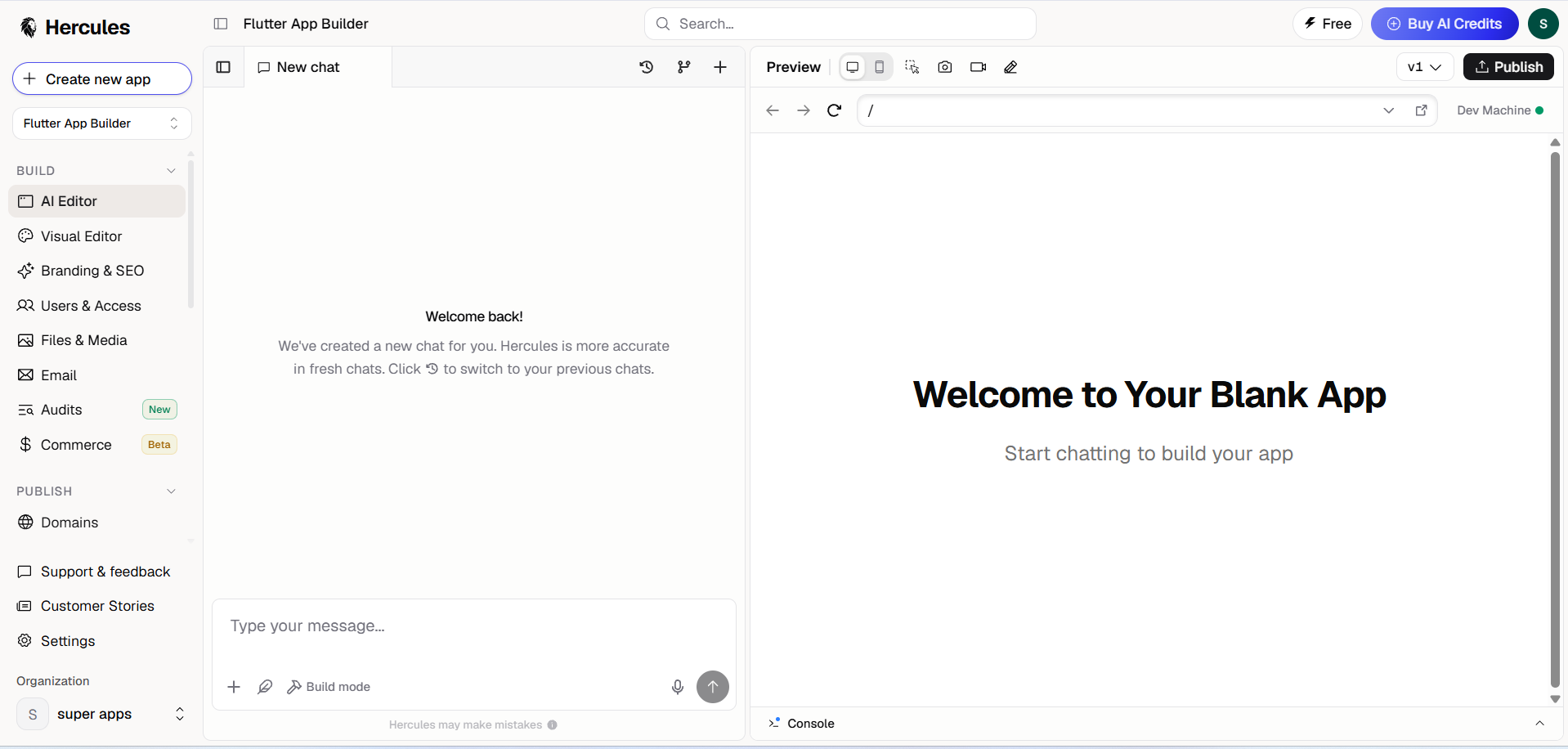
This Hercules AI app builder review starts with the basics. Hercules (hercules.app) is an AI app builder aimed at business software — CRMs, ERPs, internal ops tools, inventory trackers, HR portals — rather than consumer SaaS landing pages. You describe what you need in a chat box and it builds a working, deployed application with a database, authentication, hosting, and file storage already wired up.
Founder Brendan Falk previously co-founded Fig (Y Combinator ’20, acquired by AWS in 2023).
Two things make it structurally different from most of the category:
It publishes to real app stores. Google Play, the iOS App Store, and the Microsoft Store are documented paths, not marketing copy — with important caveats we cover in a separate post.
It shows you your code for free. This sounds minor. It is not, and it’s the single biggest practical differentiator we found — more on this below.
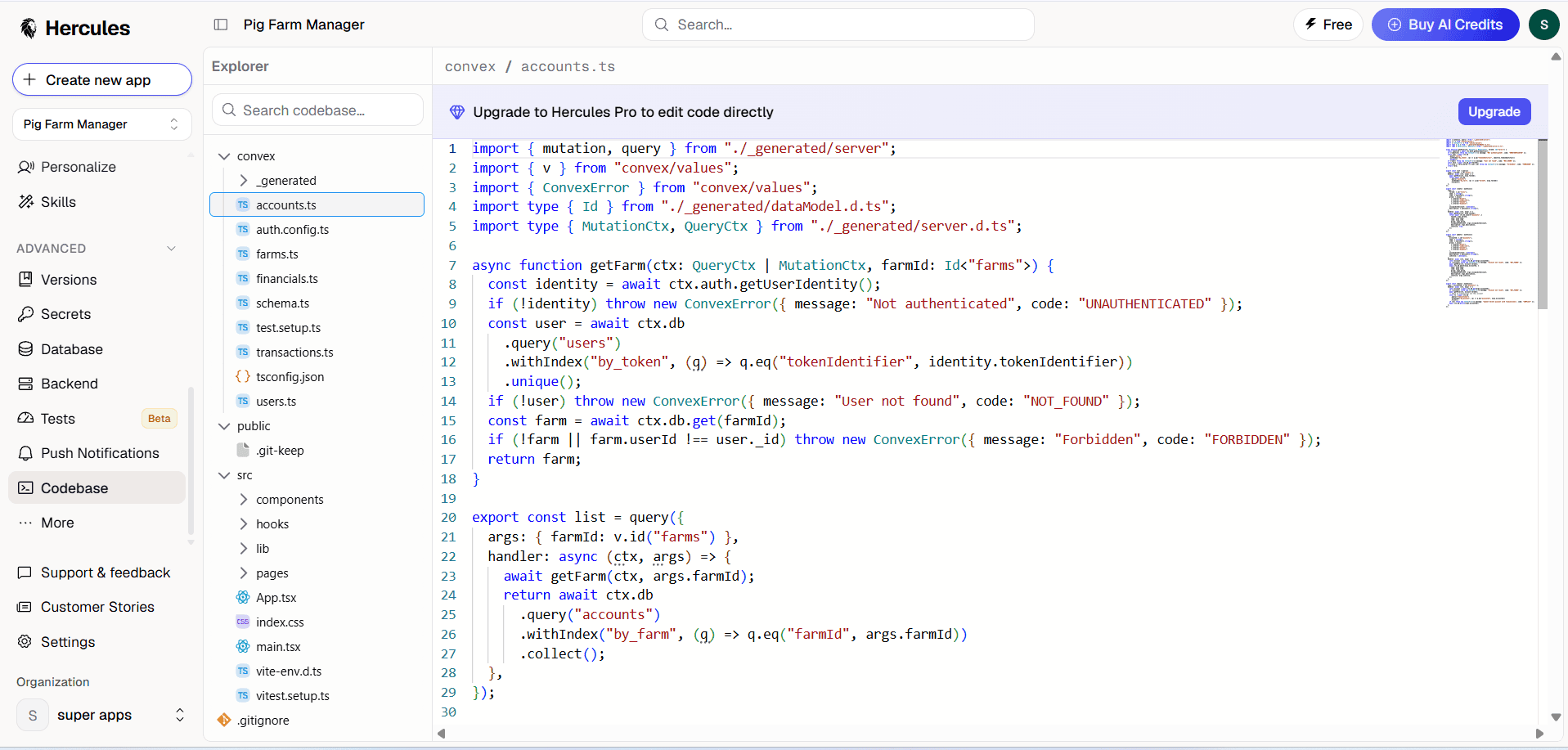
Stack: React and TypeScript on the frontend, Convex on the backend. We confirmed this firsthand by reading the generated files, not from marketing material.
Pricing (verified from the in-app billing screen):
| Plan | Price | AI credits/month | Key additions |
|---|---|---|---|
| Free | $0 | 15 | Unlimited apps, publish on a hercules.app subdomain, community support |
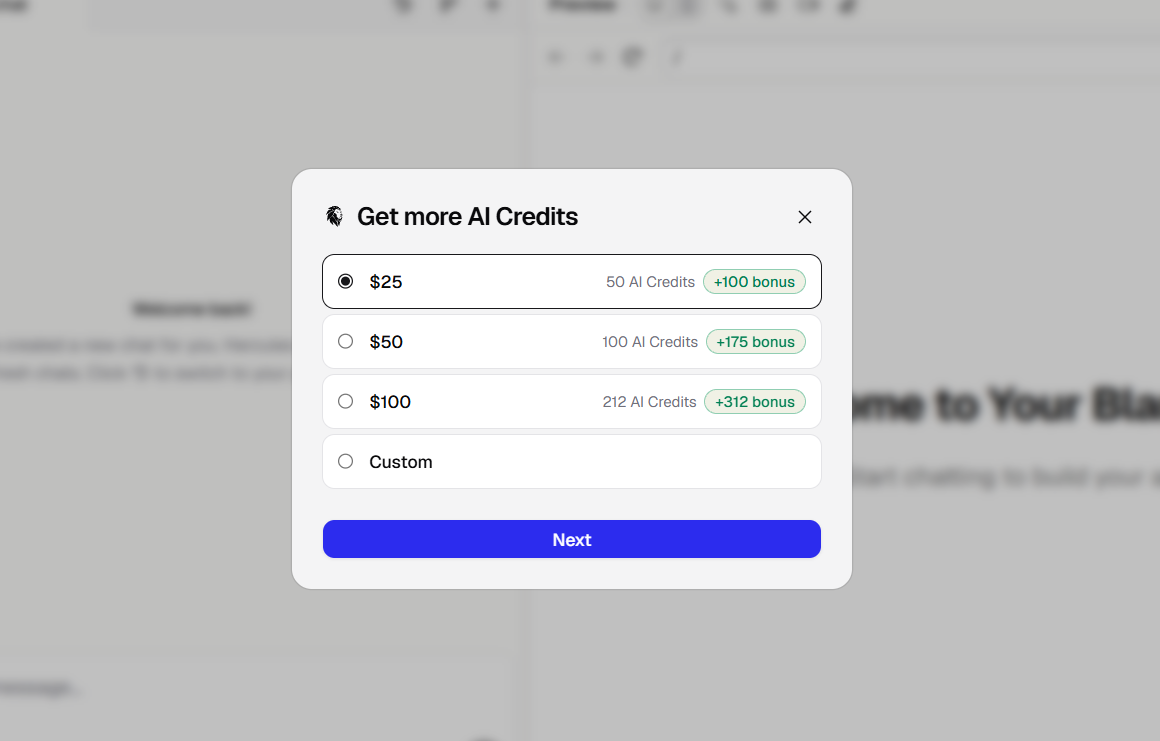
| Pro | $25/mo | 50 | Custom domains, badge removal, credit top-ups, 20× cloud usage, email support |
| Business | $199/mo | 50 | Teammates, private publishing, role-based access control, daily backups, advanced privacy controls |
| Enterprise | Custom | Custom | SSO/SAML, audit logs, SCIM provisioning, DPA, dedicated support |
Two things worth flagging that aren’t obvious from the marketing:
Credits, not features, are the real constraint. The free tier’s 15 AI credits per month is what limits how much you can actually build. Only Pro and above can buy top-ups, so on free you simply stop when the credits run out.
Business at $199 gives you the same 50 credits as Pro at $25. The 8× price difference buys team and governance features — teammates, RBAC, private publishing, daily backups — not more building capacity. If you’re a solo founder, Pro is the tier; Business only makes sense once other people need access or you need the compliance controls.
Full codebase export (a .tar.gz archive) and database export are gated to Pro and above, per Hercules’ own export documentation.
The Thing Almost Nobody Else Does: You Can Read Your Code Without Paying
On a free Hercules account, you can open the file tree and read the actual generated source of your application in the browser. Every backend function, every component. That transparency is one of the clearest findings in this Hercules AI app builder review, because a platform you can’t verify isn’t one you can fully trust.
Compare that to Emergent, a close competitor: Emergent has no in-app code viewer or file browser at all — it’s a chat-first builder — and getting at your code means connecting a GitHub repo or downloading it, which requires the $20/month Standard plan. On the free tier you cannot read what was built for you.
That gap matters far more than it looks:
You can’t audit what you can’t see. Every finding in our two investigative posts came from reading generated code. On a platform that doesn’t show it to you, none of those bugs are findable by the person who owns the app.
You can’t get a second opinion. Hiring anyone — us, a freelancer, a friend who codes — to check your app requires them to be able to look at it.
You find out what you actually bought. Reading the code is how we learned Hercules generates React rather than Flutter, and how we learned exactly which Stripe API version it pinned.
Hercules gates editing and exporting the code behind Pro, which is a reasonable business model. It doesn’t gate seeing it. That’s the right call, and we’d weight it heavily in a purchase decision.
Test 1: Real Accounting Logic
We asked for a livestock farm accounting module with genuine complexity — group-based cash flow classification with a name-based override that had to take precedence over the group check, opening balances carrying forward across fiscal years, retained earnings as a multi-term formula, a rolling 365-day working capital ratio, and PDF export in rupees.
It got the hard parts right. The classification precedence was ordered correctly. The unusual rolling-window requirement was implemented as specified. Opening-balance carry-forward was structurally sound for permanent accounts. The same classification logic appeared in two separate files and matched.
It got some textbook parts wrong. Income and expense accounts were carried forward across fiscal years instead of resetting, which compounds retained earnings incorrectly year over year. The on-screen balance sheet and the exported PDF disagreed with each other on the same figure. The working capital ratio summed transaction volume instead of point-in-time balances.
Full detail, with the arithmetic worked out: We Asked Hercules to Build Real Farm Accounting Software.
Test 2: A Stripe Billing Integration
Then we asked for something with money attached: subscription checkout, webhooks, plan entitlement, and a customer portal.
On security, it was clean across the board. Webhook signature verification implemented correctly, with the raw request body preserved. Price locked to a server-side environment variable so no client can tamper with the amount. User identity taken from the authenticated session and never from client input. Every function that writes a paid plan declared internal-only and unreachable from the browser. Customer portal scoped to the caller’s own account.
It also correctly navigated a genuinely tricky architectural constraint in the Convex backend — webhook endpoints run in a JavaScript runtime that can’t execute Stripe’s crypto, so verification has to be split into a separate Node action. The generated code did exactly that — exactly the kind of non-obvious constraint a Hercules AI app builder review needs to catch, and one the platform handled correctly.
On correctness, it slipped in the familiar way. It pinned a Stripe API version in which current_period_end no longer exists on the Subscription object (Stripe moved it to subscription items back in the March 2025 “basil” release), noticed something was off, and wrote a defensive fallback that silently stores 1 January 1970 as every subscriber’s renewal date. There was also no protection against out-of-order webhook delivery, and one race condition that drops an event without logging it.
Full detail in a separate post on that test.
Hercules AI App Builder Review: The Honest Summary
Pulling both tests together, here’s the honest verdict of this Hercules AI app builder review.
What Hercules is genuinely good at:
- Server-side authorization and data scoping, consistently, across every file we read in two apps
- Not trusting the client with anything privileged — prices, plans, user identity
- Getting unusual, explicitly-specified requirements right (the precedence rule, the rolling window)
- Correct architectural patterns for its own stack, including non-obvious ones
- Showing you the code without making you pay first
- A documented, real path to Google Play
Where it needs a human:
- Anything spanning more than one time period — fiscal years, renewal cycles, carry-forwards
- Standard domain definitions it wasn’t explicitly walked through
- API versions and library changes newer than its training
- Places where it “handles” an error by substituting a plausible wrong value instead of failing loudly
- Consistency between two views of the same number
Who we’d recommend it to: founders building internal business tools, operational dashboards, CRMs and trackers — especially anyone who wants a Play Store app without hiring a mobile developer, and anyone who values being able to read and export their own code.
Who should be careful: anyone whose app computes numbers people will make financial or legal decisions on, without a review step. Not because Hercules is worse than its competitors here — on our evidence it’s better than most — but because the failure mode is silent, and confidence in a wrong number is expensive.
One practical limitation for Indian founders: Hercules Commerce, the built-in payments feature, currently reports “Country not supported” for India, and Stripe itself is invite-only for India-based businesses rather than open self-serve signup. We cover the workarounds in a separate post.
Where SuperApps Fits
We’re not a review site. We build and run production apps — Nodik, BlogPilot, Sociophile, Videophile, PigPal — and we test AI builders because we need to know what they actually produce.
That’s also the service we sell: we read AI-generated apps against the spec you asked for and tell you where they diverge. Every bug in both of our Hercules tests was found by reading code, not by running a scanner — the same method behind every Hercules AI app builder review we publish, because scanners find vulnerabilities, and the problems in AI-built apps are mostly not vulnerabilities. They’re wrong answers that look right.
If you’ve built something on Hercules (or Lovable, Bolt, Base44, Replit, or Emergent) and it’s handling real money, real customers, or real records, we’ll review it.
Try It Yourself
If you want to run your own Hercules AI app builder review rather than take our word for it, the free tier is enough to build an app and read the generated code yourself — which is genuinely more than most competitors allow.
Required Disclosure
Disclosure: This post contains an affiliate link. If you sign up for a paid Hercules plan through it, we may earn a commission at no extra cost to you.
What that does and doesn’t change: our testing posts — including the two linked above, where we document bugs in Hercules-generated code in detail — carry no affiliate links at all, deliberately. We publish the failures with the same prominence as the successes, and we did not contact Hercules before publishing any of it. If a finding in this post would cost them a signup, it’s still in this post.
Get new posts by email
Pick the topics you care about — we only email you when something new is published in them.