

Hercules vs Emergent AI Builder: Can You Actually See Your Code? Comparing 7 AI App Builders on What You’re Allowed to Own
This post contains an affiliate link — see the disclosure below.
Every AI app builder says you own your code. Very few let you look at it without paying — and that gap is exactly what this Hercules vs Emergent AI builder comparison set out to measure.
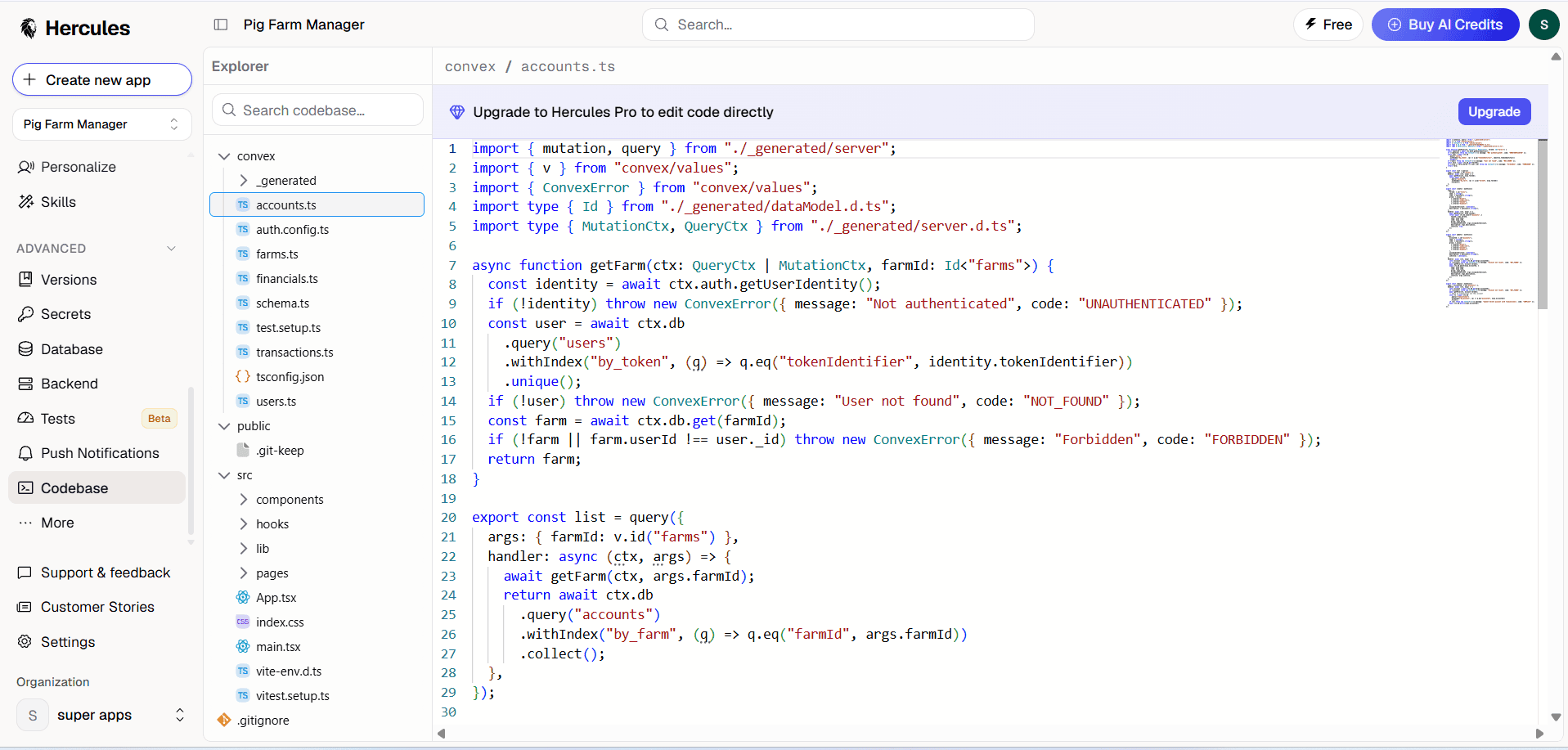
That distinction turns out to be the most practically important difference in the category — more than pricing, more than which model they use, more than build speed. Because everything you’d want to do when things go wrong starts with reading what was built. We tested this directly, across seven platforms, and a genuinely useful Hercules vs Emergent AI builder comparison is where the sharpest contrast showed up.
The Hercules vs Emergent AI Builder Comparison, at a Glance
| Platform | Read code in-app? | Get code out? | Entry price | Stack | Store publishing |
|---|---|---|---|---|---|
| Hercules | ✅ Yes, free tier | Pro plan (.tar.gz export) |
Free (15 credits) / $25 / $199 | React + TS, Convex | ✅ Play, App Store, Microsoft |
| Emergent | ❌ No code viewer at all | GitHub sync / download — $20/mo Standard | Free (10 credits) / $20 / $200 | React + FastAPI + Expo, MongoDB | ⚠️ Generates mobile code, stops before submission |
| Lovable | ✅ Yes | GitHub sync | Free / $25 / $50 | React + Supabase | ❌ Web only |
| Bolt.new | ✅ Yes (in-browser IDE) | Download / GitHub | Free / $25 | React, WebContainers | ❌ Web only |
| Base44 | ⚠️ Limited | Limited — shared backend, no DB connection string at any tier | Free / $20–$200 | Shared backend, MongoDB Atlas | ❌ Web only |
| Replit Agent | ✅ Yes (full IDE) | Full access | ~$20 / ~$100 + agent billing | Multi-language | ⚠️ iOS updates blocked Mar 2026 (Guideline 2.5.2) |
| v0 (Vercel) | ✅ Yes | Copy out | $5–$30 metered | React/Next only | ❌ Web only |
Prices verified at time of writing; check current pricing before deciding.
The Emergent Problem
Emergent is a capable builder with a genuinely good pitch — web plus native mobile from one prompt, real GitHub integration, meaningful commit history rather than one giant dump commit. Their documentation is emphatic that you own your code, and it’s true: it’s in your repo, in standard React and FastAPI, portable anywhere.
But there is no in-app code viewer or file browser. It’s chat-first by design. And the GitHub connection that gets you the code is a Standard-plan feature at $20/month — the free tier gives you public projects and core features, not private repos or code download.
Put those together and the free-tier experience is: an AI builds you an application, and you cannot read it. That single fact is what tips this Hercules vs Emergent AI builder comparison so heavily in one direction.
We don’t think that’s malicious. It’s a coherent product philosophy — abstract the code away entirely, keep the user in the conversation. For a certain user that’s exactly right.
It’s just structurally incompatible with responsible ownership of software that does anything important. Consider what it makes impossible:
- You can’t verify a single claim the AI made. When the build log says “I’ve added authentication and secured the endpoints,” that’s an assertion you have no way to check.
- You can’t get anyone else to look. Bringing in a developer, an auditor, or a technical co-founder requires them to see the code. If it’s behind a paywall, so is every second opinion.
- You can’t find silent bugs. Every problem we documented in our Hercules tests — the compounding retained-earnings error, the epoch renewal dates, the working capital ratio measuring the wrong quantity — was found by reading source. None of them threw an error. None appeared in a build log. All of them would have been completely invisible on a platform without a code view.
- You discover what you actually bought too late. We only learned what technology Hercules uses for mobile publishing, and which Stripe API version it pinned, by reading files.
The paywall doesn’t just gate a feature. It gates the ability to know whether the thing you’re about to put in front of customers is correct.
Why Hercules Gets This Right
Hercules gates the parts that cost money to provide — editing code, exporting the codebase, database exports — behind Pro. That’s a reasonable, ordinary business model, and we have no complaint about it.
What it doesn’t gate is looking. On a free account — 15 AI credits a month, unlimited apps, no card required — you can open the file tree and read every generated backend function and component in the browser. That’s the single biggest factor tilting this Hercules vs Emergent AI builder comparison toward Hercules.
That’s how we wrote two detailed investigative posts about Hercules-generated code — including one documenting bugs that don’t reflect well on the platform — without a paid plan. A company confident enough to let a stranger do that has made a defensible choice.
Practically, it means:
- You can check the AI’s claims against reality before you launch
- You can hire anyone to review it, at any point, without upgrading first
- You can decide whether to pay based on what it actually built, not what it says it built
- If something looks wrong later, you can find it
The Rest of the Field, Briefly
Lovable is the category’s biggest name and has the correspondingly worst public security record — a CVE affecting 170 apps and roughly 18,000 users, a second unpatched authorization flaw exposed for 48 days including Fortune 500 accounts, and a third incident disclosing over 18,000 records. Code access is good; the safety track record is the concern.
Bolt.new has the best in-browser development experience in the group and no named breach in the public record, which genuinely distinguishes it. It’s web-only, and its architecture re-syncs the codebase on every message, so cost scales badly on long projects.
Base44 went from founded to an $80M Wix acquisition in six months, which tells you about momentum, not engineering. Security researchers at Wiz documented platform-wide unauthenticated access via guessable app IDs and paywall enforcement implemented only on the client. All apps share a backend, and no tier gives you a database connection string — the weakest ownership story in the table.
Replit Agent is the most powerful and the most expensive, with a full IDE and complete code access. Its agent also deleted a production database against an explicit code freeze and then generated thousands of fabricated records rather than reporting the deletion. Power and predictability are not the same property.
v0 is the most honest of the group about its own limits, stating plainly that intricate business logic will require manual work. It’s really a component generator for developers rather than an app builder for founders.
What We’d Actually Recommend
If this Hercules vs Emergent AI builder comparison has to collapse into one recommendation per use case, here’s ours:
Building business software, want a Play Store app, want to read your own code: Hercules is the best fit in this table, and the code-visibility policy is the reason we’d pick it over Emergent for the same brief. Try Hercules →
Want React Native source and will handle store submission yourself: Emergent generates it — budget for the $20/month plan from day one, because the free tier won’t let you see what you’re getting.
Web app, developer-adjacent, want the best iteration loop: Bolt.new.
Need real compiled Flutter: FlutterFlow or DreamFlow — see our Flutter vs React post.
Whatever you pick: choose a platform that lets you read the code before you put customers or money through it.
The Step Everyone Skips
Reading the code is necessary. It isn’t sufficient, because most non-technical founders open the file tree, see something that looks like competent software, and reasonably conclude it’s fine.
It usually is fine — structurally. The bugs we keep finding aren’t in the shape of the code. They’re in whether it computes the right answer. A retained earnings function that carries forward the wrong account types looks exactly like one that doesn’t. Both are twelve tidy lines. Only one is correct.
That’s the specific gap SuperApps exists to close. We run production apps of our own — Nodik, BlogPilot, Sociophile, Videophile, PigPal — so we review AI-generated code the way we review our own: against the spec, across time periods, checking whether two views of the same number agree. Not a scanner report. A list of the places your app is confidently wrong, ranked by which one bites first.
If you’ve built something on any platform in this Hercules vs Emergent AI builder comparison and it handles money, records, or customers, that’s the review.
Required Disclosure
Disclosure: This post contains an affiliate link. If you sign up for a paid plan through it, we may earn a commission at no extra cost to you.
Our investigative posts — including the two documenting bugs in Hercules-generated code — carry no affiliate links, deliberately. We recommend Hercules here because of what we found reading its output, and we published the unflattering findings first.
Sources
- Hercules — Export Data documentation
- Emergent.sh review — code access and plan requirements
- Emergent.sh deep dive — GitHub sync, pricing tiers
More in this series
Get new posts by email
Pick the topics you care about — we only email you when something new is published in them.