
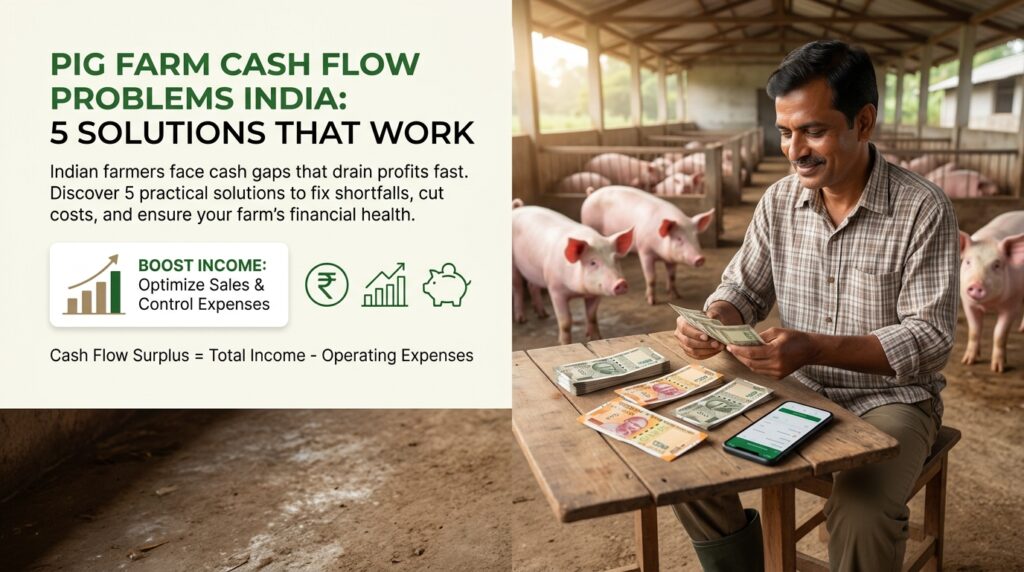
You raised the litter, managed the feed, watched over every farrowing — and yet, somehow, the money still runs short before the next sale cycle. If you are dealing with pig farm cash flow problems in India, you are not alone. Thousands of smallholder pig farmers across states like Meghalaya, Assam, and Uttar Pradesh face the same painful gap: pigs growing well on paper, but the bank account telling a different story. Understanding the profitability of pig farming starts with understanding why cash disappears before profit can materialise.
This post breaks down exactly what causes pig farm cash flow problems in India, what you can do about them, and how to build a more financially stable operation — even on a small farm with limited resources.
What Are Pig Farm Cash Flow Problems in India
Definition and Background
Cash flow is simply the movement of money in and out of your farm over time. A cash flow problem happens when money goes out faster than it comes in — even if your farm is technically profitable over the full year. Pig farm cash flow problems in India are especially common because of the long gap between purchasing piglets or feed and finally selling finished pigs, which can be four to six months or more.
Pig farming supports the livelihoods of large numbers of rural households across India, and the sector is administered by the Department of Animal Husbandry and Dairying, Government of India. For most smallholders, though, access to formal credit and financial planning tools remains limited. That financial gap creates a cycle where farmers borrow at high interest to cover feed costs, then sell pigs under pressure — often at lower prices — just to repay loans.
Why It Matters
Pig farm cash flow problems in India can force farmers to sell pigs too early (losing weight gain profit), skip essential vaccinations to cut costs, or exit the business entirely. A cash squeeze is not just uncomfortable — it can unravel years of herd improvement and farm-building work in a single bad month.
Key Benefits of Fixing Your Farm’s Cash Flow
Primary Advantages
Farmers who actively manage their pig farm cash flow problems in India unlock compounding benefits. You can negotiate better feed prices because you are not buying in desperation. You can hold pigs to optimal market weight rather than offloading early. You can reinvest in breeding stock that improves litter sizes year after year.
Who Benefits Most
Smallholder farmers managing between five and fifty pigs benefit most from addressing pig farm cash flow problems directly. At this scale, one unexpected veterinary expense or a dip in market prices can wipe out an entire quarter’s profit. Farmers at this level also rarely have financial buffers, making proactive cash management even more critical than for larger commercial operations.
How to Get Started Fixing Cash Flow on Your Pig Farm
Step-by-Step Overview
Solving pig farm cash flow problems in India does not require a financial degree. Start with these five steps:
- Map your income and expense calendar. Write down every month when money goes out (feed, vaccines, labour) and when money comes in (pig sales, breeding fees). Seeing the timeline visually reveals the cash gaps before they hit you.
- Stagger your farrowing cycles. If all your sows farrow at the same time, you sell all pigs in one month and earn nothing for the next five. Staggering farrowing across the year creates a steadier monthly income stream.
- Negotiate credit terms with your feed supplier. Many local suppliers will allow 30-day payment terms for reliable customers. This alone can ease the worst of the early-growth cash squeeze.
- Track feed conversion ratio (FCR). Wasted feed is one of the biggest silent drains on pig farm cash. Learn how to calculate FCR in pig farming and use it to cut feed waste immediately.
- Set a minimum cash reserve rule. Decide on an amount — even ₹5,000 — that you never let your farm account drop below. This buffer prevents panic selling.
Tools and Resources You Need
A simple notebook works better than nothing, but a dedicated farm management app makes cash tracking much faster and more accurate. PigPal lets you log feed costs, pig weights, and sale income from your phone, giving you a running view of your farm’s financial position at any time — no accountant required.
Common Mistakes to Avoid
Mistake #1 — Mixing Farm and Personal Money
This is one of the most damaging habits for smallholder farmers struggling with pig farm cash flow problems in India. When household expenses and farm expenses share the same cash, it is impossible to know whether your farm is profitable or whether you are subsidising it from personal savings. Open a separate account — even a basic savings account — dedicated only to farm income and expenses.
Mistake #2 — Selling Only to One Buyer
Relying on a single trader or abattoir gives that buyer enormous price leverage over you. When you are desperate for cash, they know it — and they offer less. Building relationships with two or three buyers, including direct-to-consumer channels like local markets or restaurants, gives you options and negotiating power.
How to Prevent Them
Both mistakes share a common fix: better records and better planning. Farmers who keep detailed records of every sale and every cost are far less likely to fall into these traps. If you have been losing money without understanding why, reviewing the common reasons pig farmers lose money is a practical starting point alongside your cash flow review.
Tips for Getting the Best Results
Pro Tips
- Review your cash position every week, not just at sale time. Small problems are far easier to fix than large ones.
- Build a simple break-even target for each batch of pigs before you start growing them. Knowing your minimum sale price prevents underselling. A detailed pig farm break-even calculation for India gives you a solid starting framework.
- Apply for government schemes early. Under the National Livestock Mission, NABARD acts as the subsidy channelising agency for schemes including Pig Development — but applications take time, so plan ahead rather than applying under financial pressure.
Advanced Techniques
Once your basic cash tracking is in place, consider building a 90-day cash flow forecast. Project your expected feed costs, veterinary expenses, and anticipated pig sale dates three months ahead. This gives you enough warning to arrange short-term credit before a gap hits, rather than scrambling after it arrives. Forecasting this way turns emergency borrowing — usually the most expensive money on a farm — into planned, negotiated credit.
Frequently Asked Questions
Why do pig farms in India struggle with cash flow more than other livestock farms?
The grow-out period for pigs is longer than for poultry, meaning feed costs accumulate over many months before any income arrives. Combined with limited formal credit access and volatile pork prices, pig farm cash flow problems in India tend to be more acute than for broiler chicken farmers who sell within six weeks.
Can small pig farmers really fix cash flow without an accountant?
Yes. The core practices — separating accounts, staggering farrowing, tracking FCR, and building a cash buffer — are simple enough for any farmer to implement without professional help. The key is consistency in recording numbers, not financial expertise.
How quickly can I see improvement after addressing pig farm cash flow problems?
Most farmers see a noticeable difference within one full production cycle — roughly four to six months. Staggering farrowing takes two to three cycles to fully smooth income, but the record-keeping and account-separation steps show results almost immediately by giving you clarity on where money is going.
Pig farm cash flow problems in India are real, common, and solvable. The farmers who come out ahead are not necessarily the ones with the most pigs — they are the ones who know their numbers, plan their cash gaps in advance, and refuse to let one bad season unravel what they have built.
Ready to solve it once and for all? Try it free — no credit card required.
Manage Your Pig Farm from Your Phone PigPal makes farm management simple — track breeding cycles, feed costs, and pig weights, all in one app designed for small and commercial pig farmers. Get PigPal Free →
More in this series
- Why Pig Farms Fail in India: 6 Root Causes Every Farmer Must Know (2026)
- Pig Farm Not Profitable Reasons: 7 Key Causes & How to Fix Them (2026)
- Pig Farming Losses How to Avoid: 9 Proven Steps for Smallholders
- How to Know If Pig Farm Is Profitable: 6-Step Guide for Smallholders
- Pig Feed Cost Eating Into Profit: 7 Proven Ways to Stop the Drain (2026)
- Pig Farm Break Even Calculation India: Complete Guide for Smallholder Farmers (2026)
- Profitability of Pig Farming: 7 Essential Metrics & Strategies for Smallholder Success (2026)
Get new posts by email
Pick the topics you care about — we only email you when something new is published in them.