
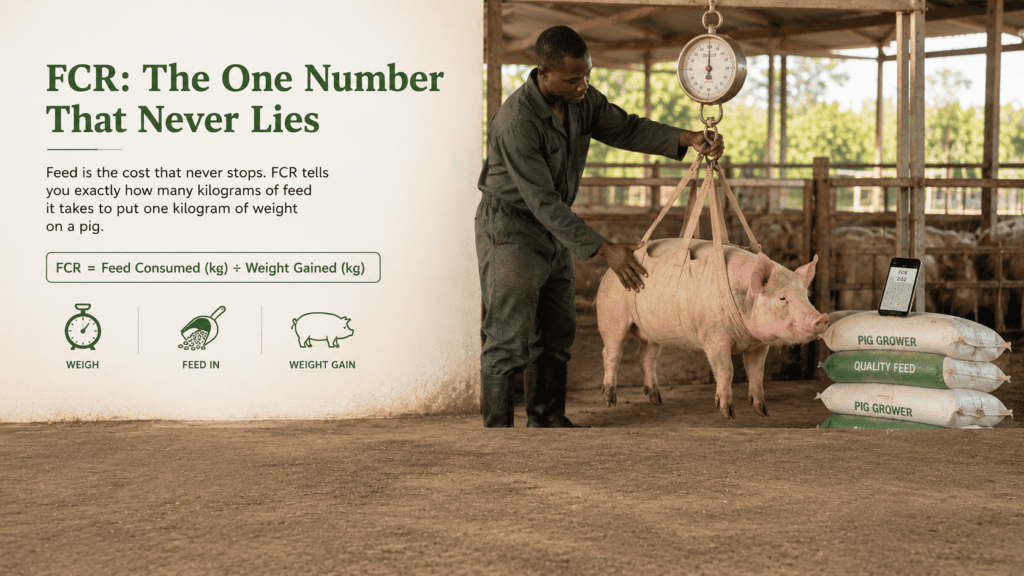
Feed is the one cost that never stops. Everything else on a piggery — housing, a boar, a water line — you pay for once and live with for years. Feed you buy again next week. That is why FCR in pig farming is the single most useful number a farmer can learn to work out: it tells you exactly how many kilograms of feed you are spending to put one kilogram of weight on a pig. Get it wrong and you can run a full-looking shed at a loss for two years without ever knowing why.
The arithmetic is simple enough to do on a phone. The hard part is having records honest enough to feed into it. This guide covers both.
What FCR in pig farming actually measures
Feed Conversion Ratio is a ratio of inputs to output: feed in, weight out. A pig with an FCR of 3.0 ate 3 kg of feed for every 1 kg it gained. A pig with an FCR of 4.5 ate 4.5 kg for the same kilogram. Lower is better — which trips people up, because in most farm metrics a bigger number is the good news.
What makes it powerful is that it collapses several separate problems into one figure. Wasted feed spilled around the trough, a ration that is short on protein, a worm burden quietly stealing nutrition, a shed that is too cold, a batch of maize gone mouldy — every one of them shows up as a worse conversion figure. You do not get told which problem it is, but you get told there is one, and you get told early.
The FCR formula, and the three numbers it needs
The formula is:
FCR = Total feed consumed (kg) ÷ Total weight gained (kg)
Weight gained is the closing weight minus the opening weight — not the closing weight on its own. This is the mistake that quietly ruins most hand-calculated FCR figures. A pig that goes from 20 kg to 80 kg has gained 60 kg, not 80. Divide by 80 and your FCR looks a third better than it is.
So you need three things recorded, with dates: an opening weight, a closing weight, and every kilogram of feed that went to that pig or that pen in between. If any one of the three is guessed, the answer is guessed.
Most smallholdings do not own a weighbridge, and that is the usual reason the first two numbers go missing. A measuring tape gets you close enough. Measure heart girth just behind the front legs and body length from between the ears to the base of the tail, both in inches, then apply the old tape formula: girth squared, multiplied by length, divided by 400, gives liveweight in pounds. ThePigSite, which has published the method for years, reports it as accurate to within about 3%. For a ratio you are tracking over months, that is entirely good enough — and it is the basis of every practical way to track pig weight without expensive equipment.

How to Calculate FCR in Pig Farming: a Worked Example
Take a pen of ten growers. You weigh them in at an average of 22 kg each, so 220 kg opening weight. Ninety days later they average 78 kg, so 780 kg closing weight. Over those ninety days the pen ate 32 bags of 50 kg — 1,600 kg of feed.
- Weight gained = 780 − 220 = 560 kg
- Feed consumed = 1,600 kg
- FCR = 1,600 ÷ 560 = 2.86
If one pig had died on day 40 at roughly 45 kg, that animal’s feed is still in the 1,600 kg but its gain has left the pen. Honest practice is to record the death, its date and its weight, and either subtract that animal’s share of feed or accept that the pen figure now includes a mortality penalty — and label it that way. Both are defensible; pretending the pig was never there is not.
What counts as a good FCR? Real benchmarks
A number without a benchmark is just a number. The Queensland Government publishes performance standards for piggeries that grade a grower herd’s liveweight feed conversion from 2.7 (“fair”) to 2.3 (“very good”), alongside a whole-herd dressed-weight figure of 4.0 down to 3.4. Those are intensive commercial units with formulated rations and controlled sheds, so treat them as a ceiling rather than a fair comparison for a smallholding.
For Indian conditions, a 2024 study of TANUVAS KPM Gold pigs on five farms in northern Tamil Nadu (Aparna and Siddharth, International Journal of Veterinary Sciences and Animal Husbandry) reported 3.61 kg of feed per kg of gain for the improved crossbred against 5.42 for desi pigs under the farmers’ existing practice. That gap — the same feed producing a third less meat — is the clearest published illustration of why FCR in pig farming is worth measuring at all.
Sources: Business Queensland piggery performance standards (grower-herd liveweight FCR); Aparna & Siddharth (2024), Int. J. Vet. Sci. Anim. Husb. 9(6):23–25. Systems differ — these are reference points, not targets for every farm.
Why FCR gets worse as pigs get heavier
This is the part most guides skip, and it changes selling decisions. As a pig grows, more of each additional kilo is fat rather than lean tissue, and fat is metabolically expensive to lay down. Feed efficiency therefore deteriorates steadily through the finishing phase.
Iowa State University’s extension factsheet Swine Feed Efficiency: Influence of Market Weight puts figures on it for high-lean genetics: feed-to-gain rises from 3.46 in the 240–250 lb band to 4.09 in the 270–280 lb band — an 18.2% loss in feed efficiency between a 245 lb and a 275 lb pig. In metric terms, the last 8 kg before slaughter cost noticeably more per kilo than the 8 kg before that.
Feed-to-gain by weight band, high-lean genetics. Source: Stender, D.R., Swine Feed Efficiency: Influence of Market Weight, Iowa Pork Industry Center, Iowa State University. Weight bands converted from pounds.
The practical reading: holding a finished pig back for another three weeks in the hope of a better price is not free. You are buying those extra kilos at your worst conversion rate of the whole cycle. Whether that trade is worth making depends on what the pig actually fetches — which is a separate problem, and one that has more to do with where and how you sell than with anything happening in your shed.
Turning FCR into rupees per kilo of gain
FCR only becomes a business tool when you multiply it by your feed price. Feed cost per kilo of gain = FCR × feed price per kg. The table below uses an example feed price of ₹30/kg — substitute whatever you actually paid.
| FCR | Feed cost per kg of gain (at ₹30/kg feed) | Feed cost to grow one pig from 20 kg to 80 kg |
|---|---|---|
| 2.5 | ₹75 | ₹4,500 |
| 3.0 | ₹90 | ₹5,400 |
| 3.5 | ₹105 | ₹6,300 |
| 4.0 | ₹120 | ₹7,200 |
| 5.0 | ₹150 | ₹9,000 |
Read down that last column and the case for measuring FCR in pig farming makes itself. The difference between 3.0 and 4.0 is ₹1,800 per pig — on twenty pigs a batch, ₹36,000 that never appears anywhere in your cash book as a loss. It simply never became income.
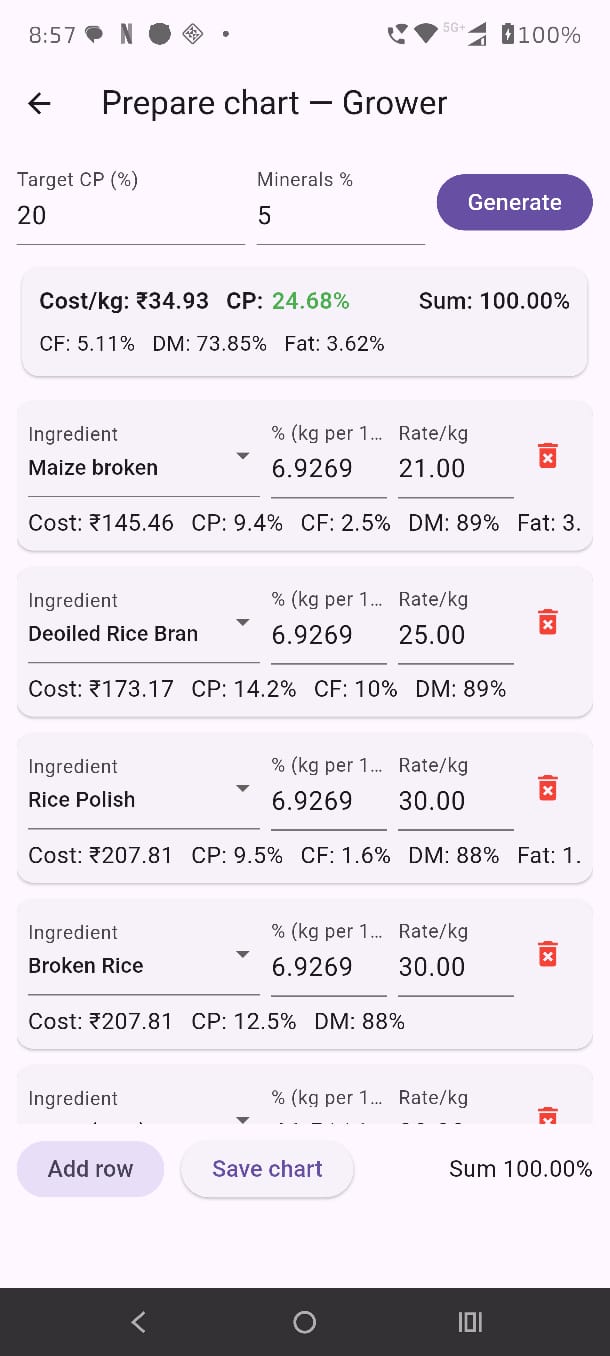
There are two levers on that number, and you should pull the cheaper one first. Improving conversion — better ration, deworming, warmth, less trough spillage — takes time. Lowering the price per kilo of feed can often be done this month, by mixing your own ration instead of buying finished compound feed.
Four mistakes that make an FCR figure meaningless
- Dividing by final weight instead of weight gained. The most common error, and it flatters the result by roughly a third.
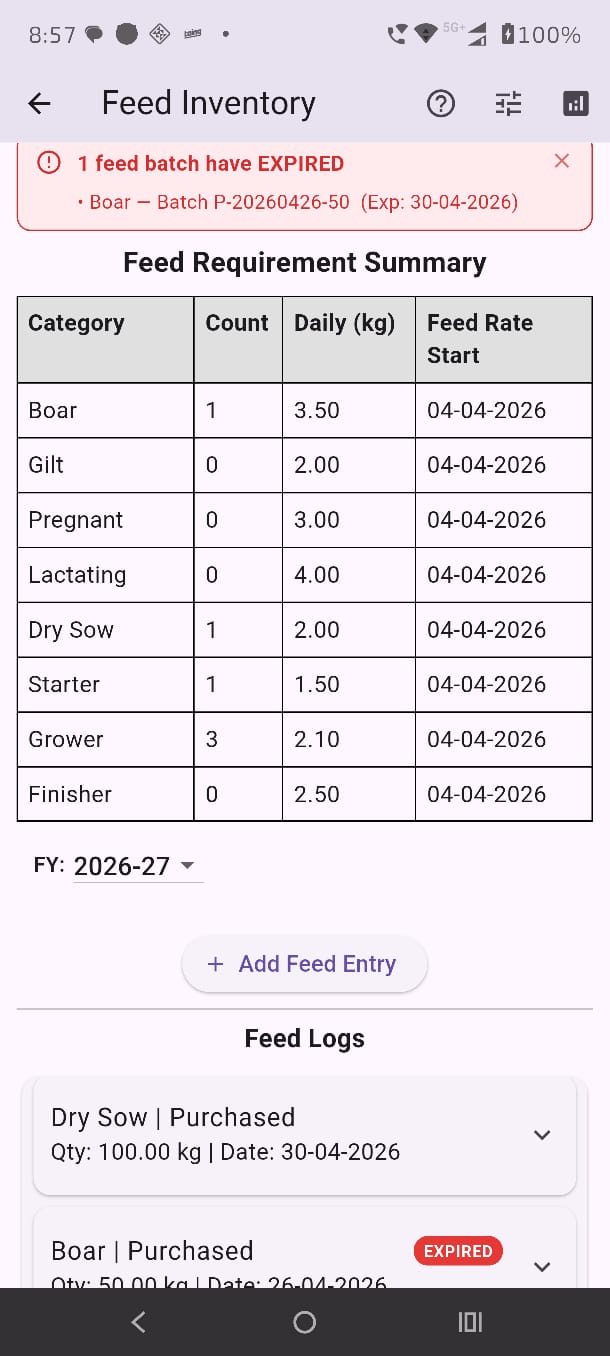
- Estimating feed by bags bought rather than bags fed. Feed sitting in the store, spoiled, sold on or eaten by another pen is not conversion — it is stock movement. Count what left the store for that pen.
- Weighing on different days of the week or at different times. Gut fill can swing a pig’s weight by a couple of kilos. Weigh at the same time of day, ideally before the morning feed.
- Mixing weight ranges and comparing anyway. Your grower figure and your neighbour’s finisher figure are not the same measurement.
How PigPal keeps the FCR calculation honest
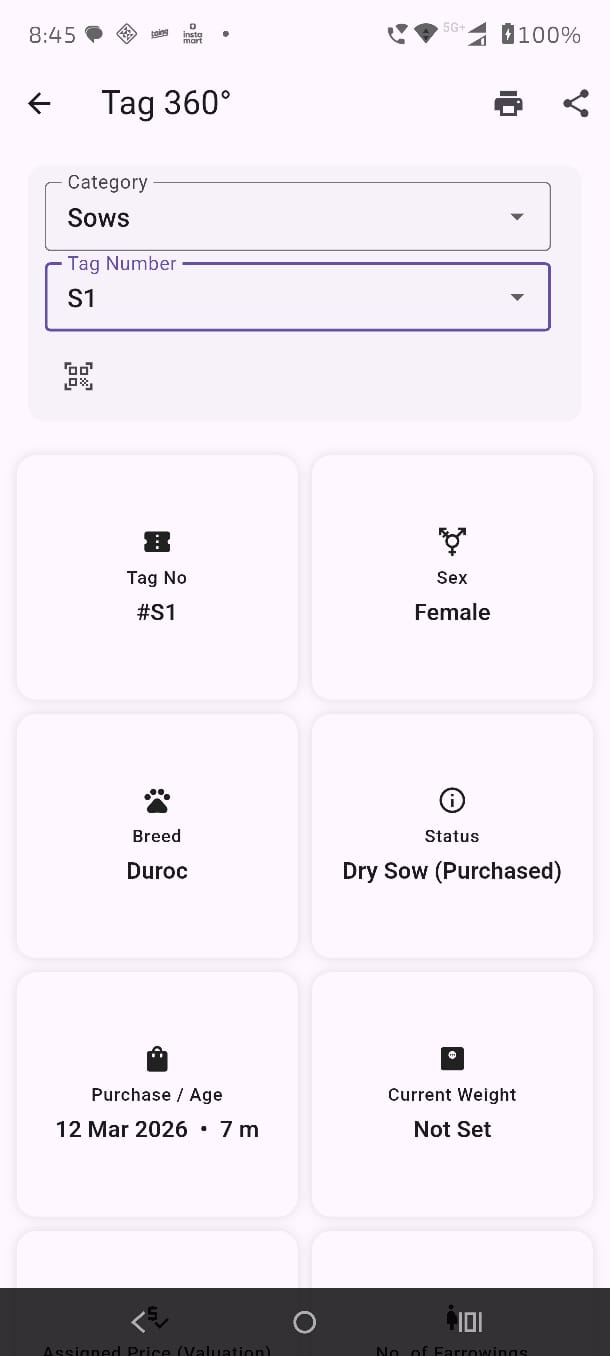
The reason most farms never calculate this is not the arithmetic — it is that the three inputs live in three different places, or in nobody’s handwriting at all. PigPal was built around that gap.
That trend line is the real payoff. A single FCR figure tells you how the last batch went. A rising line tells you something is going wrong now — usually before you can see it in the pigs. Feed intake tends to hold up for a while after health or comfort starts to slip, while gain drops off first, and the ratio widens. It is not a diagnosis, but it is a reason to walk into the shed and look properly.
None of this changes what your pigs sell for, of course. Tight feed conversion protects the cost side of the ledger; the price side is a different fight, and one worth understanding if you want to know the reasons a pig farm stops being profitable than the retail price of pork would suggest. If you would rather deal with buyers yourself, PigMart lets you list pigs for sale without a middleman.
Start with one pen
You do not need to weigh the whole herd to begin. Pick one pen. Weigh it, write the date, weigh out the feed that goes to it, and weigh again in sixty days. That one number, honestly arrived at, will tell you more about your farm’s economics than a year of guessing. Work out FCR in pig farming for a second pen on a different ration and you have something better still — a comparison you can act on.
For the wider feeding system this sits inside — stage-wise rations, ingredient choice and shed management — the ICAR-National Research Centre on Pig’s Package of Practices for Organized Pig Farms is the standard Indian reference and is freely available from the Centre.
Further Reading
- Feed Conversion Ratio in Pigs: What the Number Really Means
- Improving Pig Feed Efficiency
- Feed Cost Optimization for Pigs
- PigPal Feed Tracking Features
More in this series
Get new posts by email
Pick the topics you care about — we only email you when something new is published in them.