
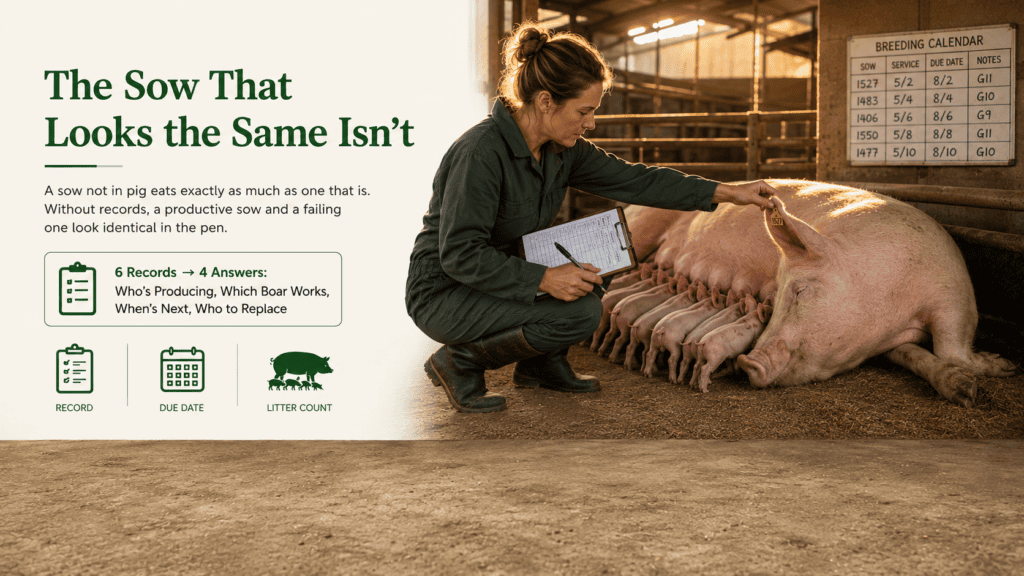
A sow that is not in pig eats exactly as much as one that is. That single sentence is the whole argument for pig breeding records: the cost of a pig breeding herd is fixed and continuous, while its output is lumpy and easy to lose track of. Without written records, the sow that has given you three small litters and two failed services looks identical, standing in the pen, to the one carrying eleven piglets.
Tracking breeding and fertility is not about paperwork for its own sake. It is about being able to answer four questions: which sows are producing, which boar is working, when the next litter is due, and which animal to replace. This guide covers the six records that answer them.
The six pig breeding records to keep
Each pig breeding record below is one line written on the day it happens. Together they form a complete reproductive history for every female on the farm.
- The mating. Sow tag, boar tag, date, and whether it was a first or repeat service. The boar tag is the field most often skipped and the one that later turns out to matter most.
- The pregnancy check. Whether she returned to heat, and the result of any ultrasound scan, with dates.
- The expected farrowing date. Mating date plus 114 days — calculated once, written down, and used to plan.
- The farrowing. Total born, born alive, stillborn, mummified, and the split between males and females. Recording only “the litter” loses the two figures that matter most.
- The weaning. Date and number weaned. Pre-weaning mortality falls straight out of this and record 4 without any extra work.
- The return to heat. Days from weaning to the next standing heat, and the outcome of that service.
The reproductive calendar every record hangs off
Pig breeding records are only useful against a timetable, which is why a written breeding schedule for pigs is the first thing to pin up. The figures below come from the ICAR-National Research Centre on Pig’s Package of Practices for Organized Pig Farms.
| Event | Timing |
|---|---|
| Oestrous cycle length | 18–24 days, average 21 |
| Duration of oestrus | 36–48 hours in gilts; 48–72 hours or more in sows |
| Gestation | 114 days |
| Return to oestrus after weaning | Most sows, 3–7 days |
| Duration of farrowing | Usually 1–4 hours |
| Interval between piglets | 10–20 minutes |
Two of those rows are decision triggers rather than trivia. A sow that has not returned to oestrus 3–7 days after weaning is losing you productive days, and every one of them costs feed with no litter attached. And a farrowing that runs well past four hours, or a gap of far more than twenty minutes between piglets, is the point at which you stop watching and call a veterinarian.
The 114-day figure is worth committing to memory in its traditional form: three months, three weeks and three days. Mated on the 1st of January, she is due around the 25th of April.
Five fertility numbers worth measuring against
Once you have a season of pig breeding records, five figures fall out of them. The Queensland Government publishes performance standards for piggeries with a range from “fair” to “very good” for each — useful as a direction of travel rather than as a pass mark, since they describe intensive commercial units.
| Measure | Fair | Very good |
|---|---|---|
| Pigs born alive per litter | 10.5 | 12.5 |
| Stillborn per litter | 1.0 | 0.8 |
| Pre-weaning mortality | 13.0% | 8.0% |
| Farrowing rate | 82% | 88% |
| Litters per sow per year | 2.1 | 2.4 |
The relative distance between the “fair” and “very good” bands for each measure, computed from the Business Queensland figures in the table above. Pre-weaning mortality has by far the widest gap — which is where most farms have the most to gain.
Farrowing rate is the one to compute first, because it is the cheapest to fix. It is simply the proportion of services that result in a farrowing. A rate well below the fair band usually points at heat detection or service timing rather than at the animals themselves — and both are management problems you can change this month without spending anything.
Which sow to keep, and which to replace
This is the decision pig breeding records exist to support, and getting it wrong is expensive in both directions. Cull too early and you throw away a breeding sow in her best years; cull too late and you feed a passenger for eighteen months.
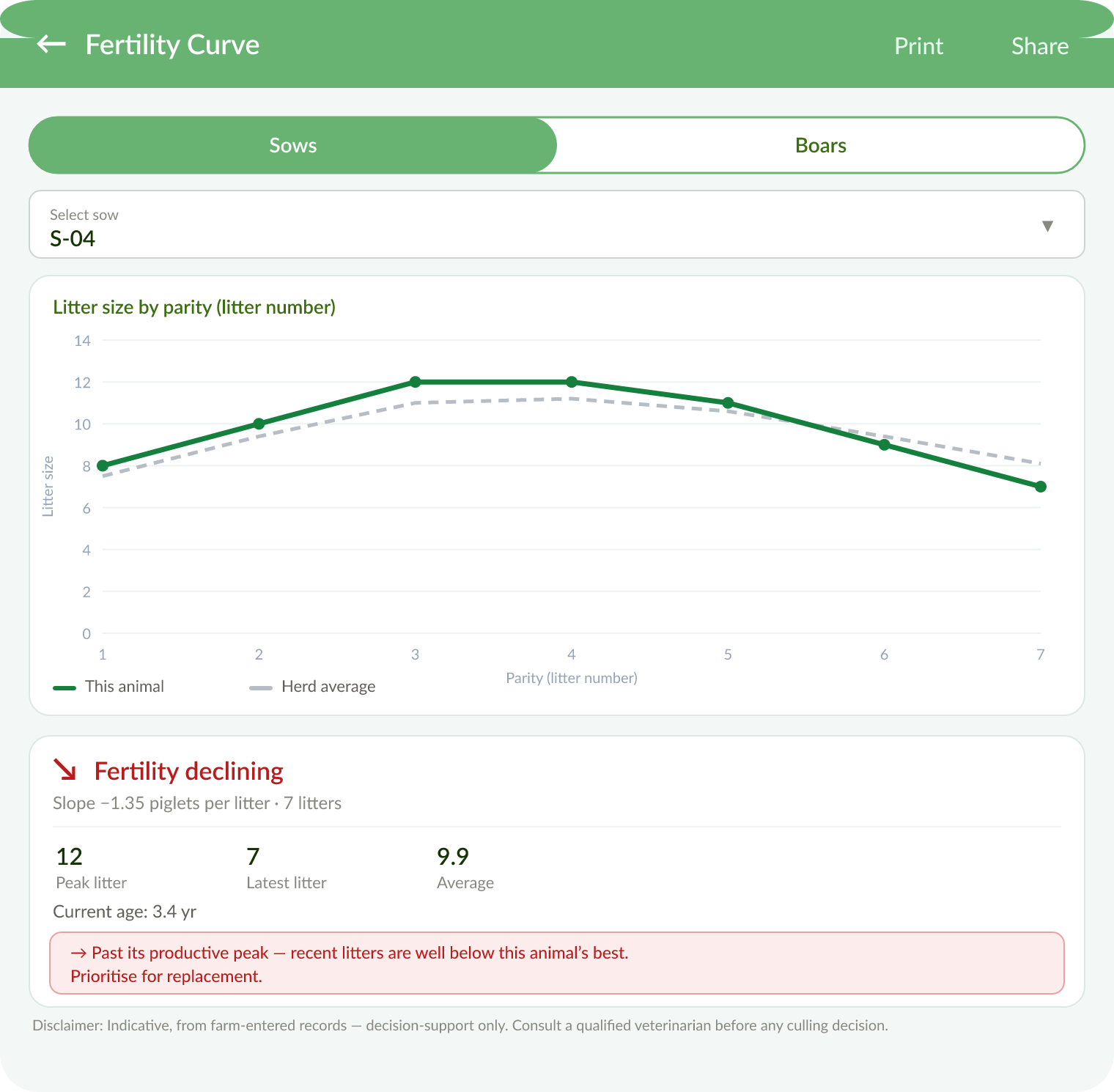
Litter size does not stay flat across a sow’s life. A Pork Information Gateway factsheet by B.A. Belstra of North Carolina State University describes the pattern precisely: litter size “is smallest at parity 1, increases up to parity 4, 5, or 6 and then tends to plateau until it begins to decrease around parity 8”. A small first litter is therefore normal and not a reason to cull; a shrinking sixth and seventh litter is a different signal entirely.
Which is why the useful view is not a single litter but the whole breeding sequence, plotted against the herd’s own average.
Which boar and sow pairings actually work in pig breeding
This is the payoff for recording the boar tag at every mating, and it is invisible without that one field. Once you have a season of services logged, you can group outcomes by pairing rather than by animal: average litter size, conception rate, pre-weaning survival and post-weaning weight for each boar-and-sow combination you have used.
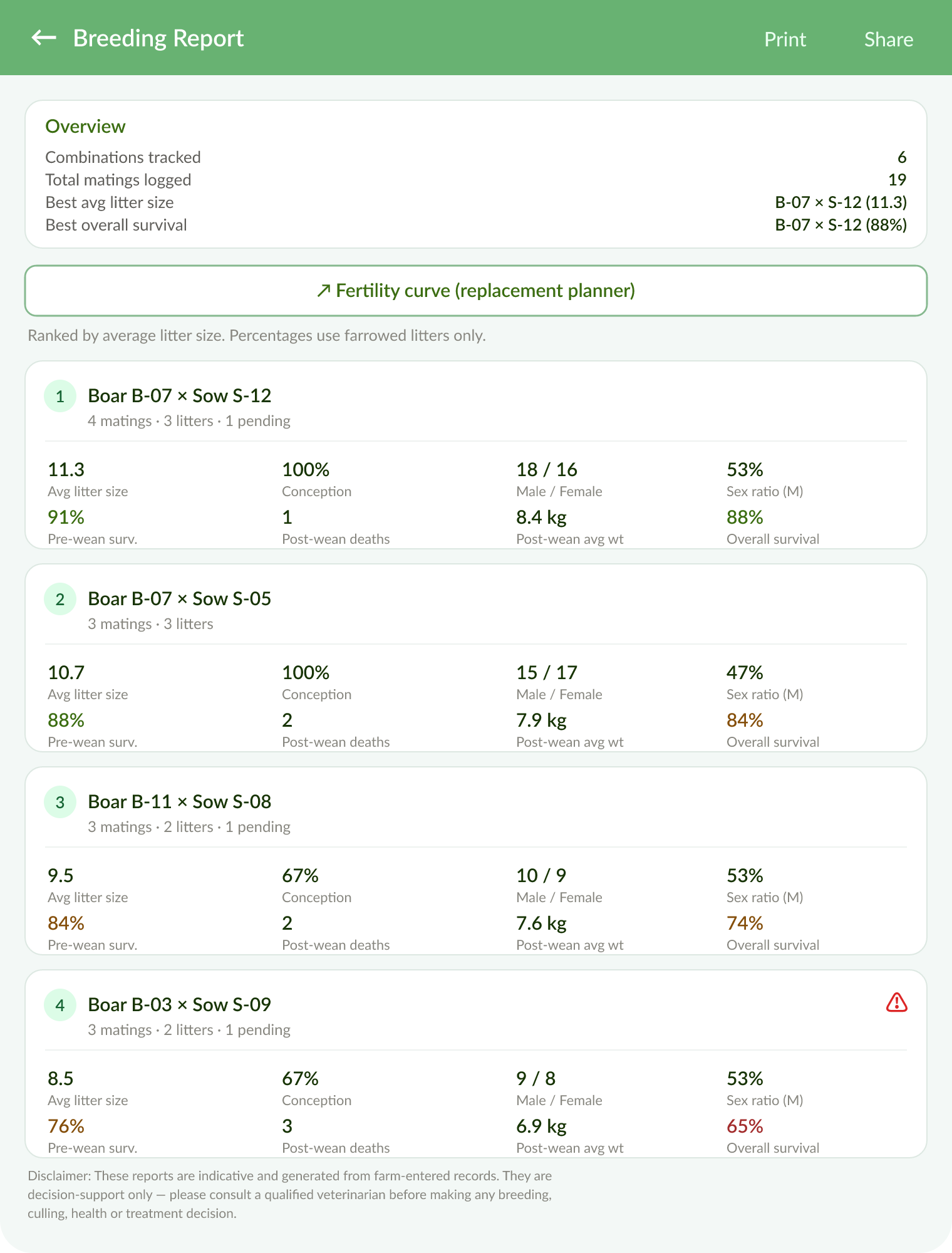
Read this kind of report with the sample size in front of you. A conception rate of 67% across three matings means exactly one service failed — that is not a pattern, it is a coin landing on one side twice. Differences only start to mean something after several litters per pairing, and even then a difference in pre-weaning survival may say more about which farrowing pen the sow was in than about the boar.
Used carefully, though, this is how a smallholding improves its pig breeding stock without buying anything: keep gilts out of the pairings that consistently produce well, and retire the boar that consistently does not.
The relationship problem nobody tracks
Any farm that retains its own gilts is three or four years away from an inbreeding problem, and it will not announce itself. Inbreeding shows up as gradually smaller litters, weaker piglets and more of them dying before weaning — all of which look like ordinary bad luck one litter at a time.
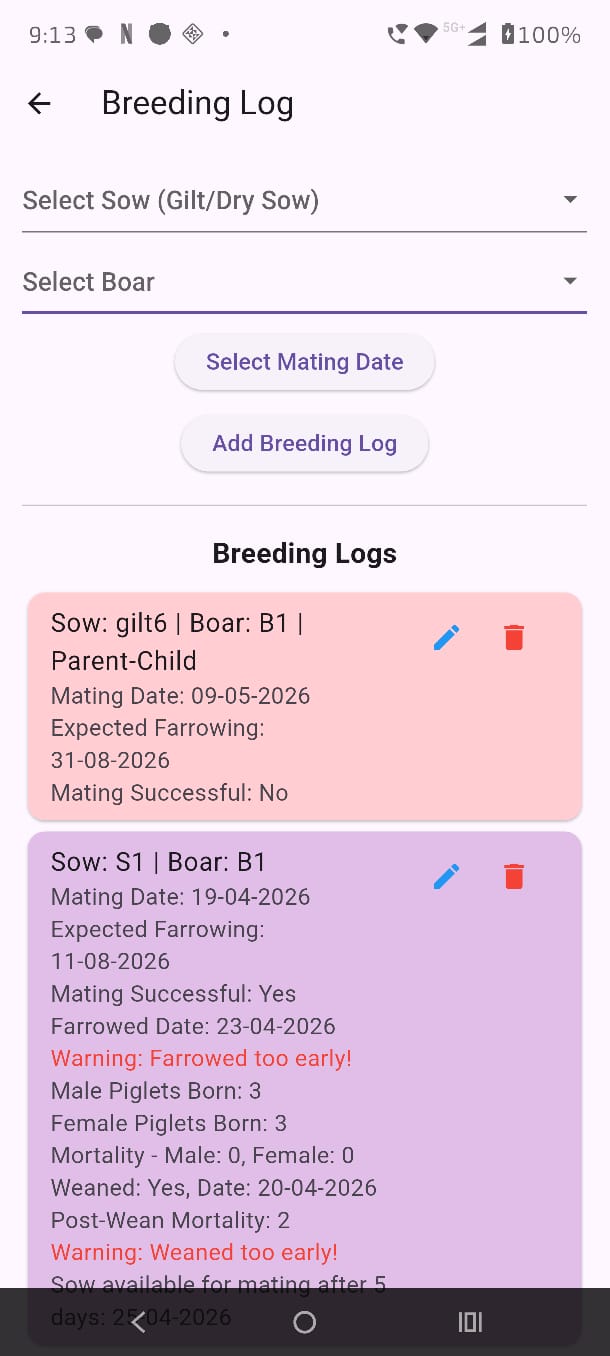
The only defence is knowing who is related to whom, which means recording the sire and dam of every animal you keep back. Once that exists, checking a proposed mating is a lookup rather than a memory test. PigPal traces ancestry across several generations and flags parent-child, full-sibling and common-ancestor pairings on the record itself, stopping the trace at animals bought in from outside.
What the records are worth outside the shed
A pig breeding history is also a sales document. A gilt offered with her dam’s litter sizes, her own birth date and her vaccination record is a different proposition from one offered as “good gilt, ready”. Buyers pay for information because information reduces their risk, and a small farm that keeps records has something to sell that a trader physically cannot supply.
That is a real edge in a market where demand is strong but documented supply is thin. It is also the practical case for why an app beats a notebook for records: a notebook cannot produce a summary for a buyer, and a farmer who arrives at the sale with nothing to show has nothing to bargain with. If you are early in this, pig breeding basics covers the ground beneath this guide — and when you are ready to sell, you can sell pigs directly in Northeast India and attach the animal’s own record to the listing.
Start your pig breeding records with the next mating
You cannot reconstruct a pig breeding history backwards, and there is no point trying. Start with the next service: sow tag, boar tag, date, due date. Add the farrowing when it comes. Within one cycle you will have something no amount of walking through the shed can give you — and within two years you will have the thing that actually improves a herd, which is four seasons of comparable records on the same animals.
Take the next step: Try it free — no credit card required.
Manage Your Pig Farm from Your Phone. PigPal makes farm management simple — track vaccinations, breeding cycles, feed costs, and pig weights all in one app designed for small and commercial pig farmers.
Further Reading
Get new posts by email
Pick the topics you care about — we only email you when something new is published in them.